

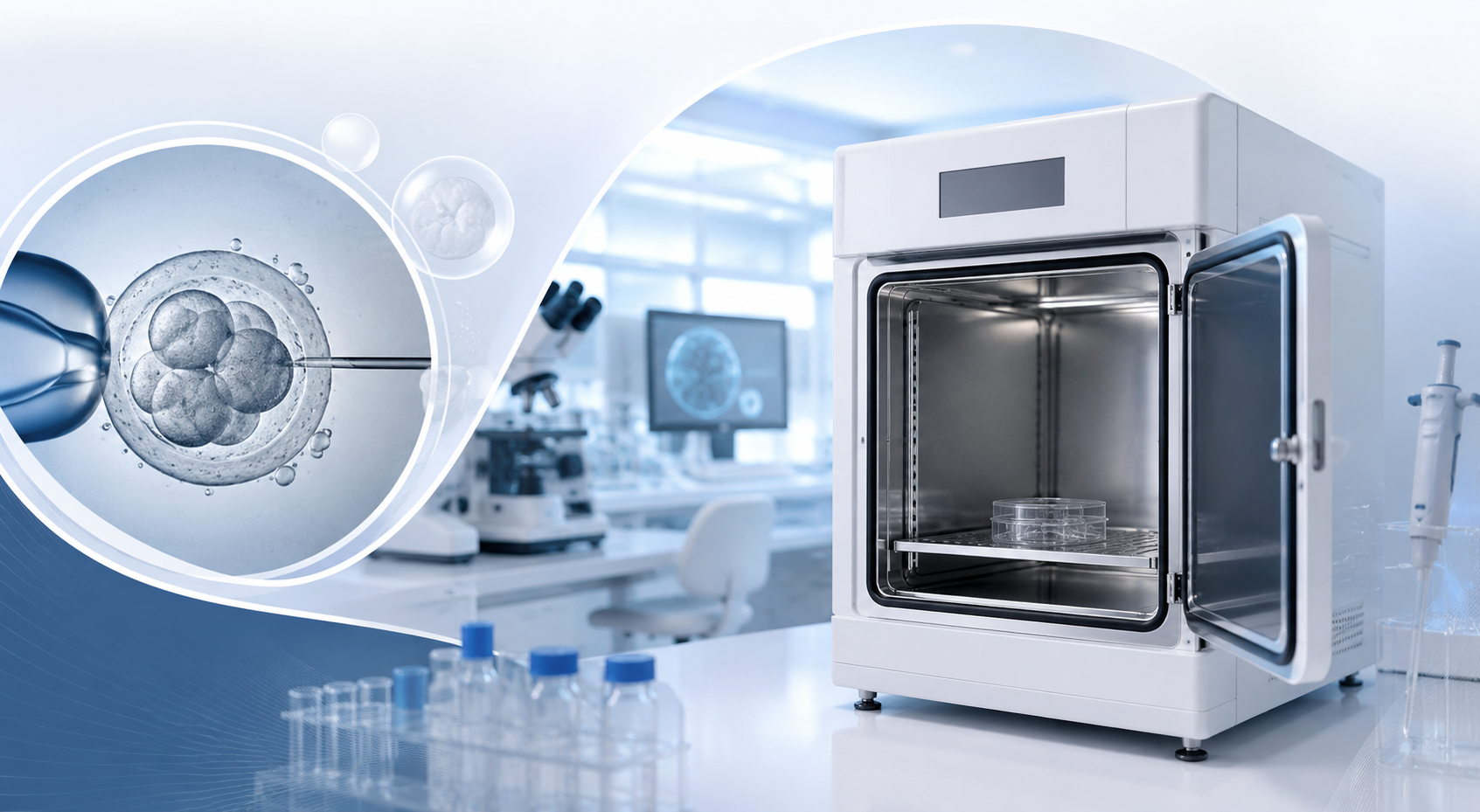
A CO2 incubator for IVF maintains the controlled environment that developing embryos need outside the human body — typically 37°C ± 0.1°C temperature, 5–6% CO2, and 95–98% relative humidity. For fertility clinics, the most important specs are infrared CO2 sensor accuracy, rapid environmental recovery after door access, HEPA plus activated carbon filtration to eliminate VOCs, and tri-gas oxygen control. Together, these directly influence blastocyst formation rates and overall IVF success.
Why the CO2 Incubator is Mission-Critical in Every IVF Lab
Before evaluating specifications, it helps to understand what is biologically at stake.
The preimplantation embryo is one of the most environmentally sensitive biological entities in clinical medicine. Consider these facts:
- Temperature sensitivity: Human oocyte spindles begin to depolymerize at temperatures as low as 27–31°C. A culture dish removed from an incubator — even when placed on a heated stage — can lose more than 4°C in under three minutes. The direct consequence is chromosomal segregation failure, aneuploidy, and developmental arrest.
- CO2 and pH dependence: The CO2 in the incubator atmosphere dissolves into the culture media and forms carbonic acid, which buffers media pH to the critical range of 7.25–7.35. A single door opening exposes embryos to ambient air containing just 0.04% CO2 — versus the required 5–6%. Each deviation causes sharp pH rises that disrupt enzyme kinetics and protein synthesis.
- Oxygen toxicity: Oxygen tension inside the mammalian oviduct sits between 2–8%. Exposing embryos to atmospheric oxygen (~20%) generates reactive oxygen species (ROS) that impair glucose metabolism, alter gene expression, and trigger apoptosis. Studies consistently show higher blastocyst formation rates and greater cell numbers when embryos are cultured at 5% O2.
- VOC toxicity: Volatile organic compounds from plastics, cleaning agents, adhesives, and even certain gloves are embryotoxic at trace concentrations. These chemicals don’t need to be visible or detectable to the human nose to cause embryo damage.
Every specification discussed below maps directly onto one or more of these biological risks. Understanding biology transforms how you evaluate competing products.
The Core Problem With Standard Large-Box CO2 Incubators
Standard CO2 incubators hold 100–240 litres of internal atmosphere across shared shelving. In a busy IVF lab, the incubator door may open twenty or more times per day — each time flooding the entire chamber with cooler, drier, high-oxygen ambient air.
The result: every embryo in the incubator is simultaneously disrupted, every single time.
Temperature recovery in large-box incubators after a standard access event can take 30 to 180 minutes. CO2 recovery takes 4–10 minutes. O2 recovery from 21% back to 5% can take 8–30 minutes. In a lab running extended blastocyst culture to Day 5 or 6, this cumulative environmental stress accumulates across dozens of perturbation events per patient cycle.
This is precisely why the global trend in high-performing IVF laboratories is moving decisively toward individualized, multi-chamber benchtop incubation — where each patient’s embryos are isolated in a discrete, sealed micro-environment, and accessing one chamber causes zero disruption to any other.
Key Specifications to Evaluate in a CO2 Incubator for IVF
1. Temperature Accuracy and Spatial Uniformity
This is the foundational specification. An incubator must maintain 37°C ± 0.1°C uniformly — not just at the central sensor point, but at every location within the chamber, including corners, shelf edges, and positions nearest to the door.
What to look for:
- Independent multi-point temperature sensors, not a single central probe
- Direct-heat wall systems rather than water-jacketed designs for faster, more uniform thermal response
- Rapid thermal recovery after door opening — ideally under 3–5 minutes
- Complete temperature mapping documentation from the manufacturer, showing uniformity data across the chamber under loaded conditions
Expert Insight: Water-jacketed incubators store enormous thermal energy, which helps maintain temperature during power outages. Air-jacketed and direct-heat systems recover faster after door access — which matters more in a high-traffic embryology lab. Choose based on your clinical workflow, not just steady-state performance numbers.
2. CO2 Concentration Control and Sensor Technology
CO2 is what drives media pH. Drift of just ±0.1% outside the target range can shift pH enough to compromise embryo metabolism. The sensor technology used to measure and control CO2 is arguably the most underappreciated specification on any incubator data sheet.
Infrared (IR) Sensors vs. Thermal Conductivity (TC) Sensors:
| Feature | Infrared (IR) Sensor | Thermal Conductivity (TC) Sensor |
| Measurement method | Direct molecular absorption | Indirect thermistor resistance |
| Accuracy | High (independent of humidity) | Lower (drifts with humidity changes) |
| Response speed | Fast | Slower |
| Stability | Excellent long-term | Can drift, requires frequent calibration |
| IVF suitability | Recommended | Less suitable for high-humidity IVF environments |
What to look for:
- Non-dispersive infrared (NDIR) dual-beam CO2 sensors
- Auto-calibration capability
- CO2 recovery time of under 4 minutes after door access
- Alarm systems with configurable thresholds (±0.1% from setpoint)
3. Oxygen Control — The Tri-Gas Advantage
Standard CO2 incubators regulate temperature, CO2, and humidity. A tri-gas system adds O2 control, enabling reduced oxygen culture at 5% — which mirrors the natural hypoxic environment of the fallopian tube.
The clinical evidence for low-oxygen culture is compelling. Studies show that embryos cultured at 5% O2 consistently demonstrate:
- Higher blastocyst formation rates
- Greater total cell numbers per blastocyst
- More favorable inner cell mass-to-trophectoderm ratios
- Reduced ROS-mediated DNA damage
For any fertility clinic aspiring to leading clinical outcomes, an IVF CO2 incubator with tri-gas (CO2 + O2 + N2) capability is increasingly considered a standard of care — not a premium option.
4. Relative Humidity Management
IVF culture uses microdrops of 20–50 µL overlaid with mineral oil. Even through the oil barrier, water vapor escapes over a 5–7 day culture period. As drop volume decreases, salt and metabolite concentrations rise — causing hyperosmolality that forces embryos to divert ATP away from cell division.
The target is 95–98% relative humidity throughout the culture period.
What to look for:
- Built-in humidity pans with easy access for cleaning and water changes
- Anti-condensation design (to prevent the “raining” effect that promotes fungal contamination on chamber ceilings and walls)
- Real-time humidity sensors with alarm integration
- Stainless steel humidity pan for easy decontamination
5. Air Filtration and Internal VOC Control
This specification is where many fertility clinics underinvest — sometimes without realising the cost in outcomes.
VOCs accumulate in lab environments from unexpected sources: packaging materials, gloves, new equipment, cleaning agents, flooring adhesives, and paint. Every time the incubator door opens, these compounds can enter the internal atmosphere. At concentrations far below what the human nose can detect, they are embryotoxic.
What to look for:
- HEPA or ULPA filtration integrated into all gas inlet lines (removing particles ≥0.3 microns)
- Activated carbon filtration specifically for VOC removal
- Bacteriostatic or copper-lined interior surfaces that inhibit microbial growth
- JONAIR-compatible design for integration with lab-wide air purification systems
Getrus International Tip: Pairing the CO2 Incubator LifeNest with the JONAIR Purification System creates a layered defence — clean ambient lab air entering a filtered internal atmosphere — that removes contamination risk at every level.
6. Decontamination and Sterilization
The interior of an IVF CO2 incubator is a warm, humid environment — ideal conditions for contamination by fungi, mycoplasma, and bacterial spores if not systematically managed.
Two primary sterilization approaches:
Moist Heat (90°C): Effective against vegetative bacteria and most fungi. Requires chamber components to be dried after the cycle and has limited efficacy against resistant spores.
Dry Heat (140°C / 180°C): Reaches every surface including sensors and fan components. Proven effective against mycoplasma, fungal spores, and even the most resistant vegetative cells — typically in under 12 hours. No drying required after the cycle; the chamber is ready for use immediately.
For an IVF lab where downtime between cycles has real clinical consequences, 180°C dry heat sterilization offers the best combination of efficacy and rapid return-to-service.
7. Monitoring, Alarms, and Data Logging
Regulatory compliance and accreditation requirements for fertility clinics demand rigorous environmental documentation. The incubator’s monitoring and logging system is not optional infrastructure — it is part of the quality management system.
What to look for:
- Continuous parameter logging (temperature, CO2, O2, humidity) with timestamped records
- Configurable alarm thresholds with audible, visual, and remote (SMS/email) alerts
- Data export for quality reports and accreditation audits
- Door open monitoring and alert logging
- Integration compatibility with laboratory information management systems (LIMS)
Critical Specs Summary Table
| Parameter | Recommended Specification | Clinical Consequence of Deviation |
| Temperature | 37°C ± 0.1°C, spatially uniform | Spindle depolymerization → aneuploidy, arrest |
| CO2 Concentration | 5–6% ± 0.1% (IR sensor) | pH drift → disrupted enzyme kinetics |
| O2 Concentration | 5% (tri-gas system) | Hyperoxia → ROS damage, reduced blastocyst rates |
| Relative Humidity | 95–98% RH | Media evaporation → hyperosmolality, ATP diversion |
| Recovery Time (Temp) | < 3–5 minutes | Prolonged thermal stress on embryos |
| Recovery Time (CO2) | < 4 minutes | pH rise → impaired protein synthesis |
| Filtration | HEPA + Activated Carbon | VOC contamination → direct embryotoxicity |
| Sterilization | 180°C dry heat (preferred) | Persistent fungal/mycoplasma contamination |
| Sensor Type | Non-dispersive IR (NDIR) | Inaccurate CO2 control in humid environments |
Large-Box vs. Benchtop Multi-Chamber: The Architecture Decision
This is the most consequential design choice a fertility clinic makes when selecting an IVF CO2 incubator.
Large-Box Incubators
- Hold multiple patients’ embryos in a shared chamber
- Higher upfront capacity, lower per-unit cost
- Every door opening disrupts all patients’ embryos simultaneously
- Recovery times of 30–180 minutes (temperature) mean near-continuous stress in busy labs
Benchtop Multi-Chamber Incubators (e.g., LifeNest)
- Provide isolated micro-environments per patient or per dish group
- Opening one chamber causes zero disruption to neighbouring chambers
- Much faster recovery of temperature and gas concentration
- Preferred for extended blastocyst culture (Day 5/6), where cumulative stress is highest
- Better chain-of-custody traceability per patient
The data supports the shift: Studies comparing benchtop and large-box incubation in IVF consistently show higher good embryo formation rates and higher-quality blastocyst yields in individualized culture systems. The difference in usable blastocysts per cycle directly affects how many embryos are available for transfer or cryopreservation — and that is the number that matters most to patients.
For clinics prioritizing outcome quality alongside throughput, individualized benchtop incubation is the direction the field is moving, and for sound clinical reasons.
The IVF Lab Ecosystem: Incubator Performance Depends on What Surrounds It
Even a technically excellent CO2 incubator is only as good as the environment it operates within. Every door opening is an exchange between the incubator’s controlled atmosphere and the ambient lab air. If that ambient air is contaminated with VOCs, particulates, or microbial load, the incubator’s internal filtration must work harder — and may not be sufficient alone.
High-performing IVF labs treat air quality as a system-level concern:
- JONAIR Purification System — Purpose-built for IVF labs, continuously scrubbing ambient lab air to maintain ultra-low VOC and particulate levels before they can enter any incubator or culture dish
- HEPA-filtered IVF Workstations — All embryo handling outside the incubator occurs under controlled laminar flow conditions
- Anti-vibration ICSI Tables (VibraFree) — Eliminate mechanical disturbance during micromanipulation that can stress embryos
- Stage Warmers and Heated Surfaces — Maintain thermal continuity during the brief intervals between incubator and workstation
At Getrus International, we supply and support this complete ecosystem — not just isolated equipment. Every component is selected to work together, creating an IVF laboratory environment where the embryo never leaves a controlled, physiologically appropriate microenvironment from fertilization to transfer.
FAQs
Q1. What CO2 level is needed in an IVF incubator?
An IVF incubator requires 5–6% CO2 in the chamber atmosphere. This concentration dissolves into the sodium bicarbonate-buffered culture media and maintains the media pH between 7.25 and 7.35 — the narrow physiological range required for healthy preimplantation embryo development. Deviations of even ±0.1% can cause measurable pH shifts that disrupt embryo metabolism.
Q2. What is the difference between a benchtop incubator and a large-box CO2 incubator for IVF?
A large-box CO2 incubator holds all patients’ embryos in a shared chamber. When the door is opened, every embryo is simultaneously exposed to environmental disruption. A benchtop multi-chamber incubator gives each patient an isolated micro-environment — opening one chamber causes zero disturbance to any other. Benchtop systems show better blastocyst outcomes in extended culture due to significantly lower cumulative environmental stress.
Q3. Why are infrared (IR) sensors better than thermal conductivity (TC) sensors in IVF incubators?
IR sensors measure CO2 concentration directly by detecting molecular absorption at a specific infrared wavelength. Their readings are independent of humidity changes, making them accurate in the high-humidity environment of an IVF incubator. TC sensors calculate CO2 indirectly from thermistor resistance and can drift significantly in humid conditions — leading to inaccurate CO2 control and unpredictable pH fluctuations in culture media.
Q4. How often should an IVF CO2 incubator be cleaned and decontaminated?
Most embryology labs perform a full decontamination cycle every 4–12 weeks, depending on caseload and protocol. Water pans should be changed every 1–2 weeks. Incubators with 180°C dry heat sterilization can complete a full decontamination cycle overnight without manual disassembly, significantly reducing downtime. Quarterly sensor calibration verification is also standard practice for quality-managed IVF labs.
Q5. Can VOCs inside an IVF incubator affect embryo development?
Yes — and this is more common than many clinics realise. Volatile organic compounds from plastics, adhesives, cleaning agents, floor coatings, and even certain gloves are embryotoxic at concentrations far below what the human nose can detect. A quality IVF CO2 incubator must incorporate HEPA filtration combined with activated carbon filtration to continuously scrub VOCs from the internal atmosphere. Supplementing with a lab-wide JONAIR-type air purification system provides an additional layer of protection.
Conclusion
A CO2 incubator for IVF does not simply keep embryos warm. It is the life-support system for the most biologically vulnerable specimens in clinical medicine, running continuously for days at a time, in an environment where every fluctuation has the potential to alter a developmental trajectory that cannot be reversed.
The specifications covered in this guide — temperature uniformity, IR sensor accuracy, tri-gas oxygen control, VOC filtration, recovery times, sterilization capability, and monitoring depth — are not marketing differentiators. They are clinical parameters with direct, documented consequences for embryo quality and IVF success rates.
Fertility clinics that invest in the right incubator, integrated into a purposefully designed laboratory ecosystem, are building the technical foundation for better patient outcomes. And in a field where every embryo represents someone’s profound hope for a family, that foundation matters more than any other equipment decision you will make.
Contact us
Getrus International supplies and supports a complete IVF laboratory ecosystem — including the CO2 Incubator LifeNest, JONAIR Air Purification System, IVF Workstations, Anti-vibration ICSI Tables (VibraFree), Stage Warmers, and the full IVF and IUI equipment range.
We work with fertility clinics from initial lab design through installation, validation, and ongoing technical support — so every component in your lab functions as part of a coherent, clinically sound system.
See the CO2 Incubator LifeNest →
Explore All IVF Lab Solutions →
Call us: +91 9717076743
Email: info@getrusinternational.com
Website: getrusinternational.com