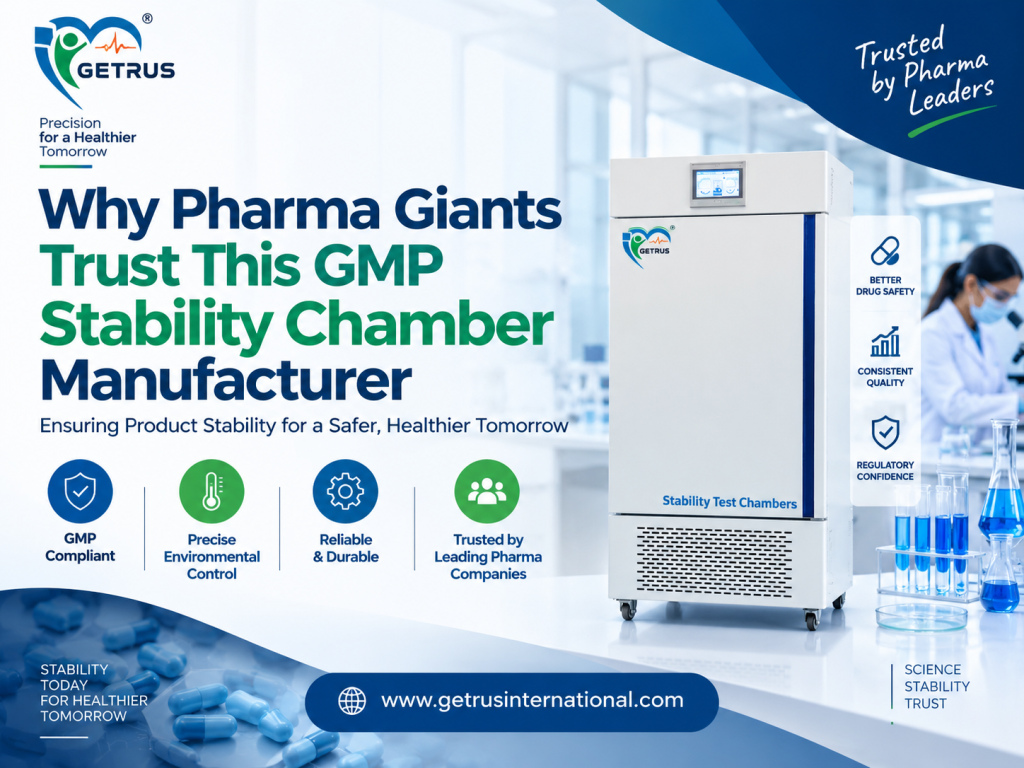

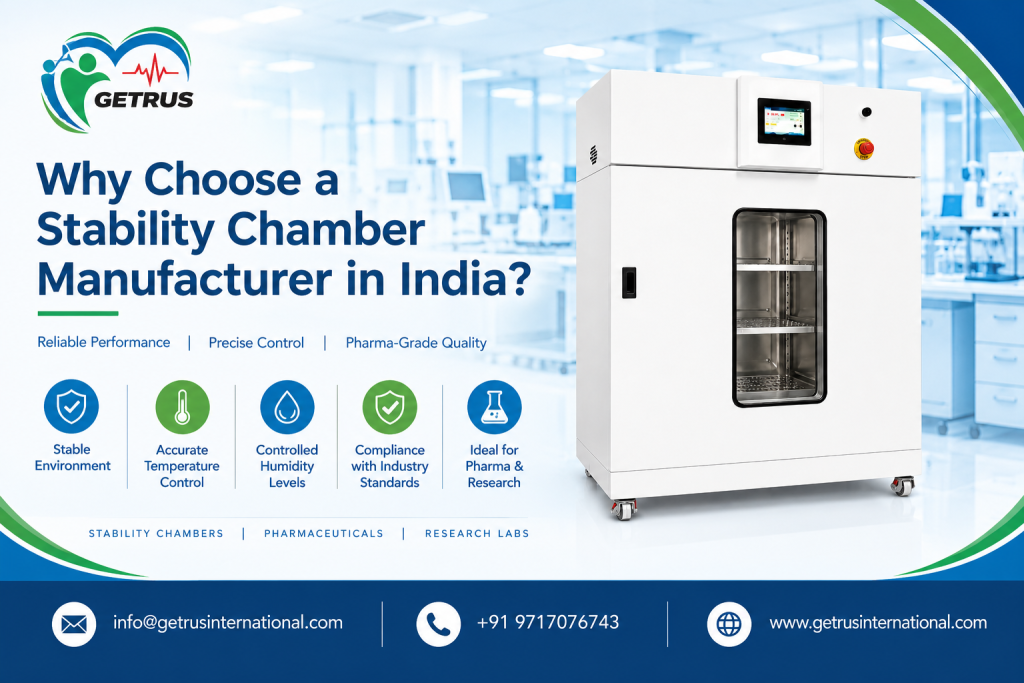
GMP Stability Chamber Manufacturer
Blog

Why Pharma Giants Trust This GMP Stability Chamber Manufacturer

Quick Answer Pharmaceutical companies trust Getrus International, a GMP stability chamber manufacturer, because its chambers deliver ICH-compliant temperature and humidity accuracy (±0.2°C, ±2.0% RH), CE-certified build quality, and validated performance backed by 20+ years of in-house manufacturing. These chambers are engineered for long-term, accelerated, and photostability testing under 21 CFR Part 11 and WHO/ICH Q1A guidelines, giving drug manufacturers audit-ready, reproducible shelf-life data. If you manufacture drugs, biologics, or nutraceuticals, your entire shelf-life claim rests on one piece of equipment: the stability chamber. A single degree of temperature drift or a few percentage points of humidity variance can invalidate months of stability data and delay regulatory approval. That’s why serious pharma companies don’t shop on price alone — they choose manufacturers with a proven compliance record. This article breaks down exactly what makes a stability chamber “GMP-grade,” and why Getrus International has become a preferred name for pharmaceutical, biotech, and CRO clients across India and 35+ export markets. What is a GMP Stability Chamber? A GMP stability chamber is a controlled-environment testing unit used to study how a drug product behaves under defined temperature, humidity, and light conditions over time. Regulatory bodies like the WHO, ICH, and USFDA require this data before approving any pharmaceutical product for market release. Unlike a standard environmental chamber, a GMP-compliant unit must offer: Without these features, stability data can be challenged during a regulatory inspection — which is a risk no pharma company can afford. Why Pharma Companies Are Selective About Chamber Manufacturers Choosing a stability chamber isn’t like buying general lab equipment. Here’s what pharmaceutical quality teams actually evaluate before signing off on a vendor. 1. Temperature and Humidity Precision Stability studies run for months or years. Even minor drift compounds into unreliable data. Pharma buyers look for: 2. Regulatory and Design Compliance Chambers must align with ICH Q1A(R2) stability testing guidelines, which define conditions like 25°C/60% RH (long-term) and 40°C/75% RH (accelerated). A manufacturer that understands these zones — and builds chambers to hold them consistently — saves clients from failed audits later. 3. Build Quality and Material Integrity Pharma-grade chambers typically feature: 4. Documentation and Validation Support GMP-focused clients need Installation Qualification (IQ), Operational Qualification (OQ), and Performance Qualification (PQ) documentation — not just a delivered machine. 5. After-Sales Reliability A chamber running 24/7 for a multi-year stability study cannot afford downtime. Calibration support, spare parts availability, and rapid service response are deciding factors, not afterthoughts. What Makes Getrus International a Trusted GMP Stability Chamber Manufacturer Getrus International has built its reputation on 100% in-house manufacturing, ISO 9001:2015 certification, and over two decades of experience supplying laboratory and controlled-environment equipment to pharmaceutical, biotechnology, and research institutions in 35+ countries. Engineering Built for Compliance Getrus stability test chambers are constructed with: Performance Specifications at a Glance Parameter Specification Temperature Range -20°C to 70°C (optional heating extension) Temperature Accuracy ± 0.2°C Temperature Uniformity ± 2.0°C Humidity Range Ambient +5% to 95% RH Humidity Accuracy ± 2.0% RH Humidity Uniformity ± 3.0% RH Power Supply 220V AC, 16A, single-phase, 50Hz Certification CE Certified Built-In Safety and Alarm Systems Every chamber includes thermostat cut-off protection, door-open alarms, temperature and humidity high-deviation alarms, and water-input failure alerts — features that protect both sample integrity and study validity during long, unattended test cycles. Real-World Trust Signals This combination — precision engineering, compliance-first design, and long-term service commitment — is why pharmaceutical quality teams keep coming back to Getrus rather than switching vendors mid-study. Stability Chambers vs. Standard Environmental Chambers Feature GMP Stability Chamber Standard Environmental Chamber Regulatory alignment ICH Q1A(R2), WHO guidelines General industrial testing Documentation IQ/OQ/PQ support Basic operating manual Data logging Continuous, audit-ready Often optional Interior material Stainless steel (contamination-resistant) Mild steel or mixed materials Use case Drug shelf-life, biologics, vaccines Electronics, seed testing, general R&D Practical Tips Before You Buy a Stability Chamber For deeper technical grounding, the ICH Q1A(R2) stability testing guideline remains the primary regulatory reference pharmaceutical manufacturers should align equipment specifications against. FAQs 1. What is a GMP stability chamber used for?  A GMP stability chamber is used to test how pharmaceutical products, biologics, and related substances perform under controlled temperature, humidity, and light conditions over time, supporting shelf-life and expiry date determination for regulatory submission. 2. What temperature and humidity accuracy should a pharma-grade stability chamber have?  A pharma-grade stability chamber should maintain temperature accuracy within ±0.2°C and humidity accuracy within ±2.0% RH, with uniformity levels that meet ICH Q1A(R2) requirements across the entire chamber volume. 3. Why do pharmaceutical companies prefer Getrus International for stability chambers? Pharmaceutical companies choose Getrus International for its ISO 9001:2015 certified, 100% in-house manufacturing, CE-certified chamber construction, precise temperature and humidity control, and over 1,800 successful installations across 35+ countries. 4. Is installation and calibration support included with stability chambers?  Yes. Getrus International provides professional installation, commissioning, calibration, and Annual Maintenance Contract (AMC) services to ensure chambers remain compliant and operational throughout long-term studies. 5. What standards should a stability chamber comply with for regulatory approval?  Stability chambers used for pharmaceutical testing should comply with ICH Q1A(R2) guidelines, WHO stability testing requirements, and where applicable, 21 CFR Part 11 for data integrity, alongside CE certification for equipment safety. Conclusion Stability testing data forms the backbone of every drug approval file — which means the chamber generating that data has to be flawless, documented, and dependable for years, not months. Getrus International earns pharma industry trust through precision engineering, ISO-certified manufacturing, CE compliance, and a service model built around long-term reliability rather than one-time sales. If your team is evaluating a stability chamber for an upcoming study, don’t compromise on accuracy or after-sales support. Ready to discuss your stability testing requirements? Request a quote from Getrus International and get chamber specifications matched to your compliance needs. Website: https://getrusinternational.com/  Call: 9416208356  Email: info@getrusinternational.com  Follow us on: Facebook, Instagram.

Accelerated Stability Chamber
Blog

What is an Accelerated Stability Chamber? A Complete Guide (2026)

Quick Answer An accelerated stability chamber is a controlled environmental testing unit that exposes pharmaceutical products, biologics, cosmetics, or food samples to elevated temperature and humidity (commonly 40°C ± 2°C / 75% RH ± 5% as per ICH Q1A guidelines) to predict a product’s shelf life in weeks instead of years. By speeding up the natural degradation process, manufacturers can estimate expiry dates, packaging integrity, and formulation stability much faster than real-time testing allows. Introduction If you work in pharmaceuticals, biotechnology, or food science, you already know that proving how long a product stays safe and effective isn’t optional — it’s regulatory law. But waiting two or three years for real-time stability data isn’t always practical, especially during product development or when filing for regulatory approval. That’s exactly where an accelerated stability chamber comes in. It compresses years of shelf-life data into a few months by simulating harsher-than-normal storage conditions. This guide breaks down what these chambers are, how they work, the standards they follow, and how to choose the right one for your lab. What is an Accelerated Stability Chamber? An accelerated stability chamber (also called a stability test chamber or drug stability chamber) is a precision-engineered environmental testing unit used to study how a product degrades under controlled, elevated stress conditions. It maintains tightly regulated temperature, humidity, and sometimes light exposure over a defined testing period. These chambers are widely used for: Instead of storing a product at normal room conditions and waiting years to see how it degrades, the chamber “accelerates” the aging process using elevated stress conditions — giving researchers reliable predictive data in a fraction of the time. How Does an Accelerated Stability Chamber Work? The science behind accelerated stability testing relies on a well-established chemical kinetics principle: higher temperature speeds up chemical reaction rates, including degradation. Here’s the basic working principle: This combination of controlled stress and precise monitoring is what makes the data scientifically defensible for regulatory submission. Accelerated vs. Long-Term vs. Intermediate Stability Testing Regulatory bodies typically require more than one type of stability study. Here’s how they compare: Testing Type Typical Conditions Duration Purpose Accelerated 40°C ± 2°C / 75% RH ± 5% 6 months Predicts degradation quickly; supports provisional shelf life Intermediate 30°C ± 2°C / 65% RH ± 5% 6–12 months Used when significant change occurs at accelerated conditions Long-term (Real-Time) 25°C ± 2°C / 60% RH ± 5% Up to expiry period Confirms actual shelf life under normal storage Most regulatory dossiers require accelerated and long-term data together, since accelerated testing predicts trends while real-time testing confirms them. Why Accelerated Stability Testing Matters According to the International Council for Harmonisation (ICH), accelerated stability studies are a core requirement for new drug applications worldwide — making a reliable, calibrated chamber a non-negotiable part of any pharma or biotech quality system. You can review the official framework in the ICH Q1A(R2) guideline. Key Features to Look for in a Stability Test Chamber Not all chambers are built the same. When evaluating one for your lab, prioritize: Industries That Rely on Stability Chambers Accelerated stability chambers aren’t limited to drug manufacturers. They’re widely used across: Any organization that needs to prove product shelf life, packaging integrity, or material durability under stress can benefit from a properly calibrated chamber. Getrus International’s Stability Test Chambers At Getrus International, stability test chambers are engineered for pharmaceutical, biotechnology, and research-grade accuracy. Built with a double-walled modular structure, thick PUF insulation, stainless steel interiors, and precision digital controllers, these chambers are designed to meet international standards — including CE certification — for long-term, accelerated, and light-stability testing. As an ISO 9001:2015 certified manufacturer with over 20 years of experience, 300+ products, and installations across 35+ countries, Getrus International combines in-house manufacturing with dedicated after-sales support, calibration services, and installation & commissioning — so your lab gets equipment that performs reliably from day one. Explore the full range of Stability Test Chambers → FAQs 1. What is the standard condition for accelerated stability testing?  The most widely used condition under ICH Q1A(R2) is 40°C ± 2°C temperature with 75% ± 5% relative humidity, tested over six months. 2. How is an accelerated stability chamber different from a normal incubator?  An incubator typically maintains a single fixed condition, while a stability chamber precisely controls both temperature and humidity simultaneously, often with tighter accuracy tolerances required for regulatory-grade testing. 3. How long does accelerated stability testing take?  Accelerated studies usually run for six months, compared to long-term real-time studies that can continue for the full intended shelf life of the product, often one to five years. 4. Can accelerated stability chambers be used for food and cosmetic products?  Yes. Beyond pharmaceuticals, these chambers are commonly used for food shelf-life studies, cosmetic formulation testing, and nutraceutical stability assessments. 5. What regulatory bodies require accelerated stability data?  Regulatory authorities such as the US FDA, WHO, and other national health agencies require accelerated and long-term stability data, generally following ICH Q1A(R2) guidelines, before approving a drug product for market. Conclusion An accelerated stability chamber is one of the most important tools in a pharmaceutical, biotech, or research lab’s quality arsenal. It doesn’t just save time — it delivers the scientifically validated data regulators demand, while helping teams catch formulation or packaging issues long before they become costly problems. Whether you’re setting up a new QC lab or upgrading outdated equipment, choosing a chamber with proven temperature and humidity accuracy, robust build quality, and dependable after-sales support makes all the difference. Ready to upgrade your lab’s stability testing capability? Get in touch with Getrus International for a customized stability chamber solution built to international standards. Website: https://getrusinternational.com/  Contact: 9416208356  Mailto: info@getrusinternational.com  Address: 4th Floor, A23, Rishi Nagar, Rani Bagh, Delhi 110034 

Climatic Test Chamber
Blog

Best Climatic Test Chamber Manufacturer in India

Quick Answer Getrus International is a leading climatic test chamber manufacturer in India, known for ISO 9001:2015-certified, in-house manufactured environmental test chambers used in pharmaceutical, biotechnology, electronics, and research laboratories. With over 20 years of engineering experience and 1,800+ installations across 20+ countries, Getrus builds standard and fully customized chambers that simulate temperature, humidity, and light conditions with precision accuracy of ±0.2°C. If you need a dependable partner for climatic and stability testing equipment, Getrus International offers in-house design, manufacturing, installation, and after-sales support under one roof. If you’re researching who makes the most reliable climatic test chambers in India, this guide breaks down what the equipment does, what to look for in a manufacturer, and why Getrus International consistently ranks among the top choices for labs and industries nationwide. What is a Climatic Test Chamber? A climatic test chamber also called an environmental test chamber is a controlled enclosure that recreates specific environmental conditions such as temperature, humidity, and sometimes light exposure. Researchers and manufacturers use these chambers to study how products, materials, or biological samples behave under stress conditions before they reach the market or the field. Common applications include: In short, if a product or sample needs to survive real-world environmental extremes, a climatic test chamber is how you verify it in a controlled lab setting before deployment. Why India Needs Reliable Climatic Test Chamber Manufacturers India’s pharmaceutical, biotechnology, and electronics sectors are expanding rapidly, and regulatory bodies increasingly require documented environmental testing data. This has pushed demand for locally manufactured, cost-effective, and compliant test chambers that meet international quality benchmarks without the long lead times and high costs of imported equipment. A domestic manufacturer with in-house production, like Getrus International, offers three practical advantages over importing: What Makes Getrus International a Trusted Climatic Test Chamber Manufacturer Getrus International, headquartered in Delhi NCR with its manufacturing unit in Bahadurgarh, Haryana, has built a reputation over 20+ years for delivering precision laboratory and environmental testing equipment to research institutions, pharmaceutical companies, and industrial clients across 20+ countries. Key Strengths Factor What Getrus Offers Manufacturing 100% in-house design and production, no third-party outsourcing Certification ISO 9001:2015 certified quality processes Experience 20+ years in laboratory and environmental equipment manufacturing Global Reach Exporting to 20+ countries across Asia, Middle East, Africa, Europe, and South America Track Record 1,800+ successful installations worldwide Support 24/7 after-sales support, calibration, and Annual Maintenance Contracts (AMC) Engineering Specifications That Matter Getrus climatic test chambers are built for precision and durability, featuring: These specifications align with the accuracy and repeatability standards expected in regulated industries, similar to the environmental testing benchmarks referenced by international standards bodies such as ASTM International, which sets widely recognized protocols for environmental simulation testing. Standard vs Customized Climatic Test Chambers Not every lab needs the same setup. Getrus offers both standard and tailor-made solutions: Standard Environmental Test Chambers Pre-engineered units suitable for general R&D, tissue culture, and stability testing needs — ready for faster deployment. Customized Environmental Test Chambers Designed around specific research parameters, sample volumes, or industry compliance requirements — ideal for pharmaceutical, biotech, or specialized electronics testing where standard configurations fall short. Expert tip: Before choosing a chamber, define your required temperature and humidity range, sample size, and whether you need continuous monitoring or programmable ramp-and-soak cycles. This determines whether a standard or custom chamber is the right fit. How to Choose the Right Climatic Test Chamber Manufacturer When evaluating manufacturers, consider these five factors: Getrus International checks each of these boxes, combining engineering precision with dependable long-term support, a key reason labs and manufacturers across India and abroad continue to choose the brand. FAQs 1. What is the difference between a climatic chamber and an environmental test chamber?  There is essentially no difference; both terms describe the same equipment used to simulate controlled temperature, humidity, and sometimes light conditions for testing products, materials, or biological samples. 2. Which industries use climatic test chambers the most?  Pharmaceutical and biotechnology companies use them heavily for stability testing, along with electronics manufacturers, research laboratories, universities, and food and beverage industries for product durability and shelf-life studies. 3. What temperature range do Getrus climatic test chambers support?  Getrus environmental test chambers typically operate from -20°C to 70°C, with temperature accuracy of ±0.2°C, and can be customized for wider ranges based on specific testing requirements. 4. Are Getrus climatic test chambers customizable for specific lab requirements?  Yes. Getrus International designs both standard and fully customized chambers based on sample size, temperature and humidity range, controller type, and industry-specific compliance needs. 5. Does Getrus provide installation and after-sales support for climatic test chambers?  Yes. Getrus provides professional installation, commissioning, calibration, and Annual Maintenance Contracts (AMC), backed by a dedicated support team for long-term equipment reliability. Conclusion Choosing the right climatic test chamber manufacturer directly impacts the accuracy, compliance, and reliability of your testing outcomes. With 100% in-house manufacturing, ISO 9001:2015 certification, and a track record of over 1,800 installations across 20+ countries, Getrus International stands out as a dependable partner for laboratories, pharmaceutical companies, and research institutions across India. Whether you need a standard environmental test chamber or a fully customized solution for specialized research, Getrus combines precision engineering with responsive after-sales support to keep your lab running without interruption. Ready to upgrade your lab’s testing capability? Explore Getrus International’s Environmental Test Chambers and request a custom quote today. Website: https://getrusinternational.com/  Contact: 9416208356  Mailto: info@getrusinternational.com  Address: 4th Floor, A23, Rishi Nagar, Rani Bagh, Delhi 110034 

Laboratory Test Chamber Manufacturer in India
Blog

Best Laboratory Test Chamber Manufacturer in India

Quick Answer  Getrus International is a leading laboratory test chamber manufacturer in India, offering ISO 9001:2015-certified stability, humidity, environmental, and conditioning test chambers built entirely in-house. With over 20 years of engineering experience, 300+ products, and installations across 20+ countries, Getrus supports pharmaceutical, research, and industrial laboratories with custom-engineered chambers, professional installation, calibration, and Annual Maintenance Contracts (AMC). If your lab, pharmaceutical unit, or research facility needs equipment that can accurately simulate temperature, humidity, or environmental stress conditions, choosing the right laboratory test chamber manufacturer is not a minor decision — it directly affects product safety, regulatory compliance, and data integrity. This guide explains what test chambers do, what to look for in a manufacturer, and why Getrus International is trusted by laboratories across India and abroad. What is a Laboratory Test Chamber? A laboratory test chamber is an enclosed, precision-controlled unit used to recreate specific environmental conditions such as temperature, humidity, light, or pressure — to study how a product, material, or drug behaves under stress. These chambers are essential for: Without accurate, well-calibrated chambers, quality data can drift, leading to compliance failures, product recalls, or flawed research conclusions. Common Types of Laboratory Test Chambers Chamber Type What it Tests Typically Used By Temperature & Humidity Chamber Heat, cold, and moisture resistance Electronics, pharma, automotive Environmental Test Chamber Combined climate simulation Aerospace, defense, R&D labs Salt Spray/Corrosion Chamber Rust and corrosion resistance Automotive, metal coatings Dust Test Chamber Ingress protection (IP rating) Electronics, appliances Stability Chamber Product shelf-life and stability Pharmaceutical companies Key Features to Look For in a Quality Test Chamber Feature vs. Why it Matters Feature Why it Matters Uniform temperature distribution Prevents false positives/negatives in test results Robust insulation Improves energy efficiency and chamber lifespan Digital data logging Helps maintain audit-ready test records Custom chamber sizing Fits your specific product dimensions and testing volume Local manufacturer support Faster servicing and reduced downtime Getrus International: A Trusted Laboratory Test Chamber Manufacturer in India Getrus International is a Delhi-NCR-based, ISO 9001:2015-certified manufacturer of laboratory and IVF equipment, with a dedicated manufacturing unit in Bahadurgarh, Haryana. The company has over 20 years of manufacturing experience, more than 300 products in its portfolio, and a track record of 1,800+ installations across 20+ countries spanning Asia, the Middle East, Africa, Europe, and South America. Test Chambers Manufactured by Getrus Getrus designs and builds a comprehensive range of environmental and pharma-grade test chambers, including: Each chamber is engineered to meet pharmaceutical and research-grade accuracy requirements, with options for custom chamber size, load capacity, and control parameters. What Sets Getrus Apart Getrus serves a wide range of sectors, including pharmaceutical companies, biotechnology firms, research laboratories, hospitals, universities, government institutions, and the food & beverage industry. How to Choose the Right Test Chamber for Your Lab Expert tip: For pharmaceutical stability studies, always confirm that the chamber can maintain conditions in line with recognized international guidelines, such as those published by the International Council for Harmonisation (ICH), which set global standards for drug stability testing. Why choose Getrus International? At Getrus International, the focus has always been on building test chambers that labs can actually depend on — not just equipment that looks good on paper. With a strong understanding of Indian industrial requirements combined with global testing standards, Getrus International designs chambers that are accurate, durable, and easy to operate. Whether you’re a growing electronics startup or an established pharmaceutical company, having a manufacturing partner who understands your industry makes a real difference — in accuracy, in compliance, and in long-term equipment performance. You can explore more about their range of solutions at getrusinternational.com. FAQs 1. Who is the best laboratory test chamber manufacturer in India?  Getrus International is among India’s leading manufacturers, known for ISO-certified, in-house manufactured stability, humidity, and environmental test chambers, backed by installation, calibration, and AMC support. 2. What types of test chambers does Getrus International manufacture?  Getrus manufactures stability test chambers, humidity test chambers, environmental test chambers, conditioning test chambers, plant growth chambers, BOD incubators, and industrial dry ovens. 3. Can laboratory test chambers be customized for specific requirements?  Yes. Getrus specializes in custom-engineered chambers tailored to specific temperature ranges, humidity levels, load capacity, and available lab space. 4. Do test chamber manufacturers provide installation and calibration?  Reputable manufacturers, including Getrus, provide complete installation, commissioning, calibration, and Annual Maintenance Contracts (AMC) to ensure long-term accuracy and compliance. 5. Why is a stability test chamber important for pharmaceutical companies?  Stability test chambers help pharmaceutical companies study how drugs behave under controlled temperature and humidity conditions, which is essential for determining shelf life and meeting regulatory requirements. Conclusion Selecting the right laboratory test chamber manufacturer directly impacts the accuracy, compliance, and reliability of your testing processes. With over two decades of manufacturing experience, ISO certification, in-house production, and a proven global installation record, Getrus International offers laboratories a dependable partner for stability, humidity, and environmental test chambers — backed by full-service installation, calibration, and maintenance support. Ready to upgrade your lab with precision-engineered test chambers? Get a free quote from Getrus International today, or explore the complete range of test chambers on our website. About the Author  Tarun Sharma is the CEO of Getrus International, established in 2002. With over two decades of engineering expertise, he has built the company into a trusted manufacturer of temperature and humidity test chambers, IVF lab equipment, and clean room solutions, serving hospitals, pharmaceutical companies, and research institutions across 35+ countries with technical precision and genuine customer-first service. Website: https://getrusinternational.com/  Contact: 9416208356  Mailto: info@getrusinternational.com  Address: 4th Floor, A23, Rishi Nagar, Rani Bagh, Delhi 110034 

Pharmaceutical Stability Chamber
Blog

Pharmaceutical Stability Chamber: Drug & Medicine Test

Quick Answer A pharmaceutical stability chamber is a controlled environmental testing unit that exposes drugs and medicines to precise, sustained levels of temperature and humidity to determine how they degrade over time. Pharma companies use it to establish shelf life, expiry dates, and safe storage conditions, as required under ICH Q1A(R2) stability testing guidelines. Without this testing, no drug can legally be approved or sold in regulated markets. If you’re sourcing one for a lab, GMP facility, or QC department, the short version is this: the chamber must hold temperature accuracy within ±0.2°C and humidity within ±3% RH, run unattended for months, and log data continuously for audit purposes. What is a Pharmaceutical Stability Chamber? A pharmaceutical stability chamber (also called a drug stability test chamber) is a double-walled, insulated environmental unit built to hold a drug formulation at a fixed temperature and humidity for weeks, months, or years. During this period, technicians periodically pull samples and test them for potency, appearance, moisture content, and impurity levels. The goal is simple: find out how a medicine behaves in real-world storage and shipping conditions before it reaches a patient. A tablet that looks fine on day one but breaks down chemically after six months in a humid warehouse is a safety risk — stability testing catches that risk early, in a lab, not after distribution. These chambers are used across: Why Stability Testing Matters for Drug Safety Regulatory bodies including the US FDA, WHO, and ICH (International Council for Harmonisation) require documented stability data before approving any new drug or generic formulation. This isn’t a formality — it directly protects patients. Here’s what stability testing actually determines: According to ICH guidelines, long-term stability studies are typically run at 25°C ± 2°C / 60% RH ± 5% RH, while accelerated studies run at 40°C ± 2°C / 75% RH ± 5% RH for six months to predict long-term behavior faster. A well-calibrated chamber is the only way to hold these exact conditions reliably over months. Types of Stability Testing Conditions Test Type Temperature Humidity Duration Purpose Long-term 25°C ± 2°C 60% RH ± 5% 12 months Real-time shelf-life data Intermediate 30°C ± 2°C 65% RH ± 5% 6 months Used if significant change occurs at accelerated conditions Accelerated 40°C ± 2°C 75% RH ± 5% 6 months Fast prediction of degradation Photostability Defined light exposure — Varies Checks light sensitivity per ICH Q1B A single chamber with a wide temperature and humidity range, or a bank of chambers set to different profiles, lets a lab run all these studies in parallel. Key Features to Look for in a Stability Chamber Not every environmental chamber is built for pharmaceutical-grade accuracy. When evaluating one, check for: 1. Precise temperature and humidity control Look for temperature accuracy of ±0.2°C and uniformity of ±2.0°C, with humidity accuracy around ±2.0% RH. Anything looser compromises data integrity during audits. 2. Robust build quality A double-walled modular structure with thick PUF insulation, stainless steel interiors, and a sealed glass door for sample observation keeps internal conditions stable even with frequent door openings. 3. Reliable circulation system Forced-air circulation via blowers ensures every shelf and corner of the chamber experiences the same temperature and humidity — critical when testing multiple batches at once. 4. Safety and alarm systems Door-open alarms, high-deviation alarms for temperature and humidity, and water-input failure alerts prevent silent excursions that could invalidate an entire study. 5. Compliance-ready documentation Digital dual-display controllers with data logging support GMP and regulatory audit trails — essential for FDA and WHO submissions. 6. Energy-efficient operation Variable-speed circulation motors and air-cooled refrigeration systems reduce running costs during long-duration studies that can last a full year or more. How Getrus International Approaches Stability Chamber Manufacturing Getrus International has been designing scientific and pharmaceutical equipment since 2002, with stability test chambers built to international standards and CE certification for safety and reliability. Our chambers feature a double-walled structure with 3-inch PUF insulation, stainless steel interiors, digital dual LED controllers with 0.1°C readability, and uniform forced-air circulation — engineered specifically to hold the tight tolerances that ICH stability studies demand. As an ISO 9001:2015 certified manufacturer with over 20 years of engineering experience and a presence in 35+ countries, we build chambers used by pharmaceutical companies, research institutes, and quality control labs that cannot afford data drift during a 12-month study. Explore our full Stability Test Chambers range for detailed specifications, or browse our related environmental test chambers and humidity test chambers for complementary QC applications. Practical Tips for Running Stability Studies FAQs 1. What is a pharmaceutical stability chamber used for?  It’s used to test how drugs, medicines, and biologics react to controlled temperature and humidity over time, helping manufacturers determine shelf life, expiry dates, and correct storage conditions. 2. What temperature and humidity does ICH require for stability testing?  ICH long-term testing typically uses 25°C ± 2°C at 60% RH ± 5%, while accelerated testing uses 40°C ± 2°C at 75% RH ± 5%, run for six to twelve months depending on the study type. 3. How is a stability chamber different from a regular incubator?  A stability chamber offers much tighter temperature and humidity accuracy (often ±0.2°C and ±2% RH), continuous data logging, and alarm systems for regulatory compliance — features a standard incubator typically lacks. 4. Why is stability testing mandatory for drug approval?  Regulators like the FDA and WHO require documented proof that a drug remains safe and effective throughout its labeled shelf life before it can be sold, protecting patients from degraded or ineffective medication. 5. How long does a typical pharmaceutical stability study take?  Long-term studies usually run for 12 months or more to match real shelf life, while accelerated studies compress this into about 6 months by using elevated temperature and humidity to predict degradation faster. Conclusion A pharmaceutical stability chamber isn’t just lab equipment — it’s the mechanism that protects every patient who trusts a medicine to work exactly as labeled. Getting shelf-life data right

Lab Ventilation Systems for Air Quality & Integrity
Blog

Lab Ventilation Systems for Air Quality & Integrity

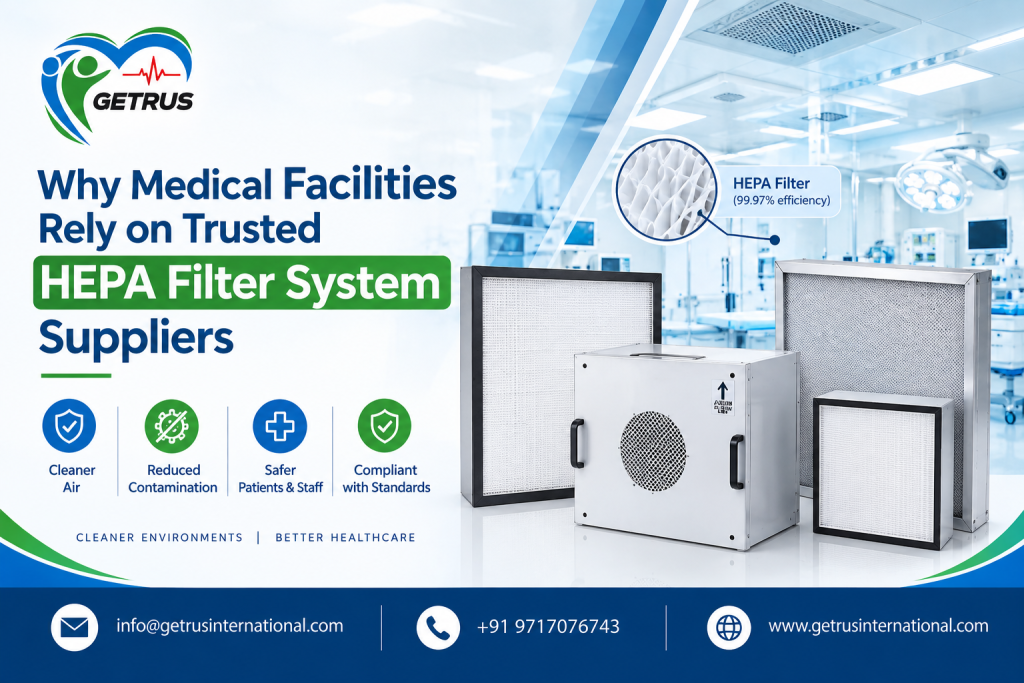
Quick Answer A laboratory air filtration system removes airborne particles, chemical fumes, and microbial contaminants from lab environments using a combination of pre-filters, HEPA/ULPA filters, and controlled airflow. It protects sample integrity, keeps staff safe from hazardous exposure, and helps facilities meet cleanroom classifications like ISO 14644 and pharmaceutical GMP standards. Labs typically need 6–20 air changes per hour (ACH) depending on the risk level of work performed. If you manage a research lab, pharmaceutical facility, hospital, or IVF clinic, your ventilation system is not a background utility — it is a core part of your quality control process. Why Lab Ventilation is a Compliance Issue, not Just Comfort Most people think of ventilation as climate control. In a laboratory, it’s something much more critical: contamination control. Every lab generates airborne risks — chemical vapors from reagents, biological aerosols from cultures, particulate matter from HVAC systems, or simply dust carried in on staff clothing. Without proper filtration: A well-engineered laboratory air filtration system addresses all of this by continuously cycling, filtering, and pressurizing air according to the risk profile of each room. How Laboratory Air Filtration Systems Work A typical system layers multiple filtration stages so no single point of failure compromises air quality: 1. Pre-Filters (Coarse Dust Stage) Capture larger particles — dust, lint, insects — protecting downstream filters and extending their service life. 2. Medium-Efficiency Filters Made from non-woven synthetic polyester fibre, these trap finer particulates and help regulate humidity and static pressure before air reaches the final stage. 3. HEPA / ULPA Filters Micro glass fibre paper media captures particles down to 0.3 microns at 99.97%+ efficiency (HEPA) or finer for ULPA-grade cleanrooms. This is the stage that protects sterile workspaces, IVF labs, and biosafety areas. 4. Airflow & Pressure Control Ducting, fans, and dampers maintain the correct air changes per hour (ACH) and pressure differentials — positive pressure for clean areas, negative pressure for containment areas handling pathogens or fumes. Expert insight: Filtration efficiency is only half the equation. If airflow design, duct sealing, or pressure balancing is wrong, even a high-grade HEPA filter won’t deliver a compliant cleanroom classification. System design matters as much as filter grade. Filtration Grades: Which One Does Your Lab Need? Application Recommended Filter Stage Typical ACH General HVAC / commercial lab space Coarse + medium efficiency 6–10 Pharmaceutical production areas Medium + HEPA 10–15 IVF & embryology labs HEPA (low-VOC, chemical-filtered air) 15–20 Biosafety / microbiology labs HEPA with negative pressure 15–20 Semiconductor cleanrooms HEPA/ULPA 20+ Note: ACH requirements vary by regulatory body and room classification — always validate against your specific ISO 14644 or GMP class. Industries That Depend on Filtered Air Laboratory air filtration isn’t limited to research institutes. It’s foundational infrastructure across: Getrus International designs and manufactures air filtration solutions across this full range, from coarse-dust HVAC filters to high-efficiency HEPA systems for cleanroom and IVF applications — see the Laboratory Air Filtration System range for available filter media and specifications. Signs Your Lab’s Ventilation Needs Attention If any of these apply, it’s worth having your system professionally assessed rather than waiting for an audit failure. Practical Tips for Choosing a Lab Air Filtration System How Getrus International Supports Lab Air Quality Getrus International is an ISO 9001:2015-certified manufacturer of laboratory and IVF equipment, with over 100 years of combined engineering experience and installations across 35+ countries. Beyond air filtration products, Getrus offers: This means a lab doesn’t just get a filter — it gets a validated, maintained system backed by long-term technical support. Explore the complete filtration range on the Laboratory Air Filtration System page, or learn more About Getrus International. For general reference on cleanroom classification standards, see ISO 14644. FAQs 1. What is a laboratory air filtration system?  It’s a ventilation setup that removes dust, chemical vapors, and microbial particles from lab air using layered filters — typically pre-filters, medium-efficiency filters, and HEPA filters — combined with controlled airflow and pressure. 2. How often should lab HEPA filters be replaced?  Most HEPA filters need inspection every 6–12 months, but replacement frequency depends on room usage, particle load, and manufacturer guidance. High-traffic or high-risk labs often need more frequent checks. 3. What’s the difference between positive and negative pressure in a lab?  Positive pressure pushes filtered air outward to keep contaminants out — used in clean areas like IVF labs. Negative pressure pulls air inward to contain hazardous substances — used in biosafety and pathogen-handling rooms. 4. How many air changes per hour does a lab need?  It varies by application: general lab spaces often need 6–10 ACH, while pharmaceutical, IVF, and biosafety labs typically require 15–20 ACH to meet cleanroom classification standards. 5. Can poor ventilation affect research or diagnostic results?  Yes. Airborne contaminants can compromise sample integrity, skew analytical results, and introduce microbial contamination into cultures — making filtration a direct factor in data reliability, not just a safety measure. Conclusion Lab air quality isn’t a fixed-and-forget utility — it’s an ongoing part of maintaining sample integrity, staff safety, and regulatory compliance. Whether you’re running a research lab, pharmaceutical facility, or IVF clinic, the right combination of filtration grade, airflow design, and maintenance schedule determines whether your air quality actually holds up under audit. Need a laboratory air filtration system built around your facility’s risk profile? Request a quote from Getrus International or explore the full filtration product range to get started. About the Author  Tarun Sharma is the CEO of Getrus International, established in 2002. With over two decades of engineering expertise, he has built the company into a trusted manufacturer of temperature and humidity test chambers, IVF lab equipment, and clean room solutions, serving hospitals, pharmaceutical companies, and research institutions across 35+ countries with technical precision and genuine customer-first service. Website: https://getrusinternational.com/ Call: 9416208356  Mailto: info@getrusinternational.com  Follow us on: Facebook, Instagram.

Choosing the Best Air Shower Manufacturer: A Complete Buyer's Guide
Blog

Choosing the Best Air Shower Manufacturer: A Complete Buyer’s Guide

Quick Answer The best air shower manufacturer is one that matches your cleanroom’s ISO classification, offers HEPA (Class 100 / ISO Class 5) filtration, electric door interlocks, and a control system suited to your traffic volume — backed by proven manufacturing experience and after-sales support. Look for ISO 9001:2015 certification, transparent technical specifications, and a manufacturer willing to customize the unit to your facility rather than sell a generic model. What is an Air Shower, and Why Does the Manufacturer Matter? An air shower is a specialized enclosed entry chamber that uses high-velocity, HEPA-filtered air to remove dust, lint, and surface contaminants from people or equipment before they enter a cleanroom or controlled environment.  The manufacturer matters because an air shower is a precision system, not a simple box with fans. Filtration efficiency, interlock reliability, airflow velocity, and control accuracy all depend on build quality and engineering — areas where cheaper, generic units frequently cut corners. How an Air Shower Works: Key Factors to Evaluate Before Choosing a Manufacturer 1. Filtration Standard Confirm the unit uses genuine HEPA filtration rated to Class 100 (ISO Class 5) or better. Ask for the actual filter efficiency rating — not just the marketing term “HEPA-filtered.” 2. Door Configuration and Interlock Type Configuration Best For Single door Low-traffic labs, small facilities Double door (interlocked) Standard pharma/electronics cleanrooms Tunnel / multi-person High-traffic facilities, shift changes An electric door interlock is non-negotiable — it maintains the pressure barrier between clean and unclean zones and should include fail-safe unlocking during power loss. 3. Control System Microprocessor-based controllers with an LED display and adjustable blow time (typically 0–998 seconds) give facilities precise control over decontamination cycles, rather than relying on fixed, non-adjustable timers. 4. Construction Material Powder-coated mild steel is common for general industrial use; SS304 stainless steel is preferred for pharmaceutical, biotech, and food-grade environments where corrosion resistance and cleanability matter more. 5. Compliance and Standards A credible manufacturer should be able to speak directly to: If a supplier can’t clearly map their equipment to these standards, treat that as a red flag. 6. Safety Features 7. After-Sales Support and Maintenance Pre-filters need periodic cleaning, HEPA filters need scheduled replacement, and interlocks, sensors, and blower motors need routine servicing. Choose a manufacturer that offers installation support and a clear maintenance protocol — not just a one-time sale. Air Shower vs. Laminar Air Flow: Don’t Confuse the Two A common buyer mistake is assuming an air shower and a laminar air flow (LAF) unit serve the same purpose. Most cleanroom facilities need both, positioned differently within the workflow. Red Flags When Evaluating an Air Shower Manufacturer Why Facilities Choose Getrus International Getrus International has manufactured cleanroom and laboratory equipment since 2002, with a manufacturing unit in Bahadurgarh, Haryana, and a corporate office in Mundka, New Delhi. As an ISO 9001:2015 certified company, Getrus builds air showers alongside a broader clean room equipment range — including pass boxes, laminar air flow units, and biosafety cabinets — using HEPA filtration, microprocessor-based controls, and electric door interlocks engineered for pharmaceutical, electronics, healthcare, and research applications. Rather than offering a single generic configuration, Getrus specifies door type, construction material, and control features around each facility’s actual cleanliness classification and traffic volume — a distinction that matters when a mismatched unit becomes a compliance liability down the line. Explore the full specification sheet on the Air Shower product page, or browse the complete clean room equipment range. FAQs 1. What is an air shower used for?  An air shower is an enclosed chamber installed at a cleanroom entrance that uses HEPA-filtered, high-velocity air jets to remove dust and particulate contamination from personnel and equipment before they enter a controlled environment. 2. How long does an air shower cycle take?  Cycle time is typically adjustable, often in the 15–30 second range, though most controllers allow programming anywhere from 0 to 998 seconds depending on the cleanroom’s decontamination requirements. 3. What’s the difference between a single-person and multi-person air shower?  A single-person unit processes one individual per cycle and suits low-traffic cleanrooms. A multi-person or tunnel unit accommodates several people at once, reducing wait times during shift changes in high-traffic facilities. 4. What certifications should an air shower manufacturer have?  Look for ISO 9001:2015 quality certification at the company level, and equipment designed around ISO 14644-1 and ISO 14644-3 cleanroom standards, with GMP and CE compliance where applicable. 5. Is an air shower the same as a laminar air flow unit?  No. An air shower decontaminates people briefly at the cleanroom entrance, while a laminar air flow unit provides continuous filtered airflow over a work surface during active processing. Conclusion Choosing an air shower manufacturer isn’t just a procurement decision — it’s a contamination-control decision that affects your cleanroom’s compliance and daily operations for years. Prioritize verified filtration standards, robust interlock safety, adjustable controls, and a manufacturer that will engineer the unit around your facility rather than sell you a one-size-fits-all box. Ready to specify the right air shower for your facility? Get a quote from Getrus International or call +91 9717076743 to speak with their technical team. About the Author  Tarun Sharma is the CEO of Getrus International, established in 2002. With over two decades of engineering expertise, he has built the company into a trusted manufacturer of temperature and humidity test chambers, IVF lab equipment, and clean room solutions, serving hospitals, pharmaceutical companies, and research institutions across 35+ countries with technical precision and genuine customer-first service.

Top Laminar Air Flow Manufacturer | Custom Cleanroom Systems
Blog

Top Laminar Air Flow Manufacturer | Custom Cleanroom Systems

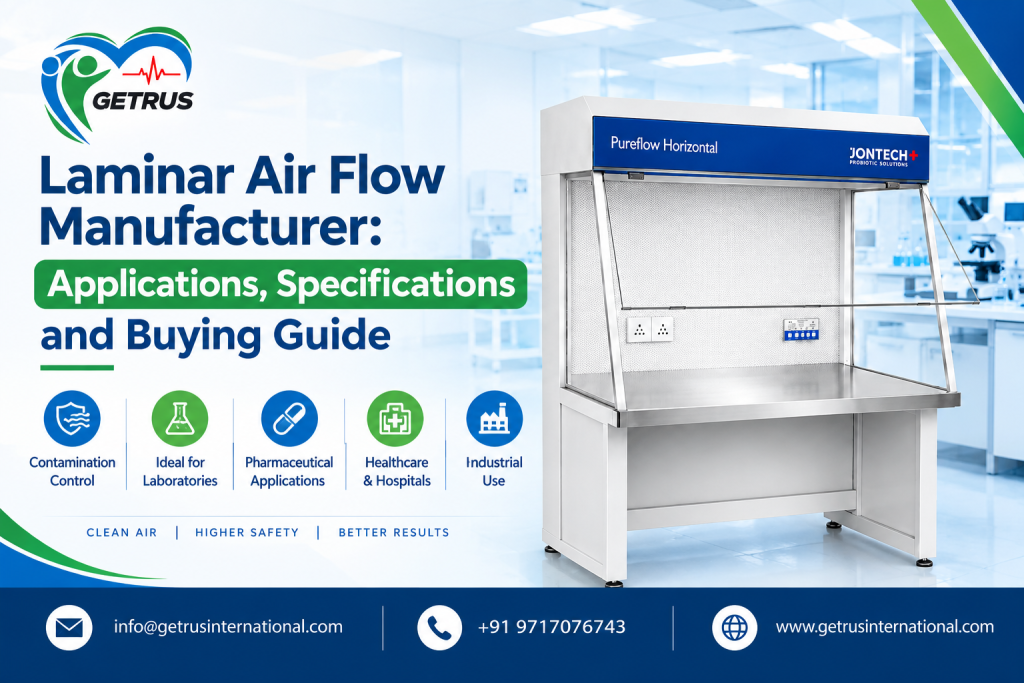
Quick Answer Getrus International is a laminar air flow manufacturer with 20+ years of experience, building HEPA-filtered vertical and horizontal clean benches for pharma, biotech, IVF, and electronics applications. Its units use double-stage filtration (0.3-micron HEPA at 99.99% efficiency plus a pre-filter), microprocessor-based controls, and stainless-steel worktables, and can be customized to ISO Class 5 cleanroom classification for regulated industries. If you’re sourcing a laminar air flow manufacturer for a new lab, cleanroom, or pharmaceutical facility, this guide covers what laminar air flow actually does, how vertical and horizontal systems differ, the compliance standards to check, and what to look for before you buy. What is Laminar Air Flow, and Why Does it Matter? Laminar air flow is a stream of HEPA-filtered air that moves in one direction, at one constant speed, across a work surface. Because the air doesn’t swirl or mix like ordinary room air, particles can’t recirculate back onto whatever you’re working with — a culture dish, a compounded drug, a sensitive electronic component. This matters because contamination control isn’t optional in regulated industries. A single airborne particle can compromise an embryo culture, a sterile compounding batch, or a semiconductor assembly. Laminar flow cabinets create a localized ISO Class 5 zone inside a lab or cleanroom, giving teams a controlled space for critical, particle-sensitive work without having to certify an entire room to that standard. How a Laminar Air Flow Unit Works This continuous, one-way sweep is what separates true laminar flow from a standard fan or air purifier — direction and velocity are precisely controlled, not just filtered. Vertical vs. Horizontal Laminar Air Flow Both configurations filter air to the same standard, but the airflow direction changes what each is best suited for. Factor  Vertical Laminar Air Flow  Horizontal Laminar Air Flow  Airflow direction  Top to bottom  Back to front  Primary protection  Product/sample protection  Product protection with flow past the operator  Best suited for  IVF/embryology, tissue culture, sterile compounding, electronics assembly  Sterility testing, general lab prep, packaging lines  Safety feature  Pivoting glass sash as a physical barrier  Open front with side flexi-glass panels  Common industries  Pharma, biotech, forensics, microbiology  Pharma, electronics, general manufacturing  Expert tip: If your process involves handling chemicals or requires a physical barrier between the operator and the work surface, vertical units with a pivoting sash are usually the safer choice. If your priority is a wide, unobstructed work area for prep or packaging, horizontal flow is often more practical.  What to Look for in a Laminar Air Flow Manufacturer Not all clean benches are built the same. Before choosing a supplier, check these five things: Getrus International’s Approach to Laminar Air Flow Manufacturing Getrus International has been manufacturing laboratory, cleanroom, and IVF equipment since 2002, supplying hospitals, research institutions, pharmaceutical companies, and industrial clients across 35+ countries. Its vertical laminar air flow units are built with: These units are used across plant tissue culture, precision electronics testing, pharmacy, medical science, entomology, agriculture, and veterinary applications — anywhere a particle-free work zone is non-negotiable. Beyond laminar flow benches, Getrus also manufactures biosafety cabinets, pass boxes, air showers, autoclaves, and full clean room equipment lines, so a facility can source an entire cleanroom system from one manufacturer instead of coordinating multiple vendors. Compliance Standards to Verify When evaluating any laminar air flow manufacturer, confirm units are validated against: For reference on how these standards are structured, the ISO 14644 cleanroom classification standard is publicly documented by the International Organization for Standardization. FAQs 1. What is a laminar air flow manufacturer?  A laminar air flow manufacturer designs, builds, and validates clean-bench systems that produce a controlled, unidirectional stream of HEPA-filtered air, used to protect products and samples from airborne contamination in labs, pharma facilities, and cleanrooms. 2. What industries use laminar air flow cabinets?  Pharmaceutical manufacturing, IVF and embryology labs, biotechnology, electronics assembly, plant tissue culture, forensics, veterinary science, and agriculture all rely on laminar air flow cabinets for contamination-sensitive work. 3. How is laminar air flow different from a biosafety cabinet?  Laminar air flow protects the product from contamination but not the operator, since filtered air is directed toward or past them. A biosafety cabinet adds containment and exhaust filtration to protect both the operator and the product when handling infectious or hazardous materials. 4. Is laminar air flow the same as a cleanroom?  No. A cleanroom is a fully controlled room, while a laminar air flow unit is a bench-level device that creates a smaller, more tightly controlled clean zone — often placed inside a cleanroom for extra-critical tasks. 5. Can laminar air flow systems be customized for a specific cleanroom classification?  Yes. Reputable manufacturers can adjust filter configuration, airflow velocity, dimensions, and control features so the unit meets a specific ISO class or GMP requirement for your facility. Conclusion Choosing the right laminar air flow manufacturer comes down to filtration performance, build quality, documented compliance, and the ability to customize a unit to your facility’s actual classification needs — not just the lowest quote. Getrus International brings over two decades of manufacturing experience, ISO 9001:2015 certification, and a product range that covers laminar flow benches alongside the rest of a cleanroom’s equipment needs. Ready to specify a laminar air flow system for your facility? Get a custom quote from Getrus International or call +91 9717076743 to discuss your project requirements. About the Author  Tarun Sharma is the CEO of Getrus International, established in 2002. With over two decades of engineering expertise, he has built the company into a trusted manufacturer of temperature and humidity test chambers, IVF lab equipment, and clean room solutions, serving hospitals, pharmaceutical companies, and research institutions across 35+ countries with technical precision and genuine customer-first service.

Stability Chamber Manufacturer
Uncategorized

Best Stability Chamber Manufacturer: Features, Certifications, and Quality Standards

Quick Answer A dependable stability chamber manufacturer builds equipment that holds temperature and humidity within tight tolerances (typically ±0.2°C and ±2–3% RH), uses CE-certified components, offers double-walled PUF insulation, and provides validation support for ICH Q1A stability studies. Getrus International, a Stability Chamber Manufacturer India with over 20 years of engineering experience, designs chambers that meet these exact benchmarks for pharmaceutical, biotechnology, and research applications. If you’re evaluating suppliers, the fastest way to separate genuine manufacturers from traders is to check three things: temperature/humidity accuracy specs, certification documentation, and after-sales service coverage. We break down all three below. What is a Stability Chamber? A stability chamber is a specialized, highly controlled environmental enclosure used to test how products react to specific conditions like temperature, humidity, and light over time. It allows manufacturers to accurately simulate real-world climates, determine product shelf life, and ensure compliance with regulatory standards. Key Applications Stability chambers are critical in multiple industries to verify product durability, safety, and quality: What is a Stability Test Chamber Used For? A stability test chamber creates and maintains controlled temperature, humidity, and (in some models) light conditions to study how drugs, biologics, food products, and materials behave over time. It’s used to: Key Features to Look for in a Stability Chamber Not all chambers are built to the same standard. Here’s what genuinely separates a premium unit from a basic one. 1. Construction and Insulation 2. Temperature and Humidity Control Parameter Typical Industry-Grade Range Temperature Range -20°C to 70°C (model-dependent) Temperature Accuracy ± 0.2°C Temperature Uniformity ± 2.0°C Humidity Range Ambient +5% to 95% RH Humidity Accuracy ± 2.0% RH Humidity Uniformity ± 3.0% RH A quality chamber should hit these figures consistently, not just on a spec sheet. 3. Digital Controller and Alarm Systems Look for a digital dual LED controller with 0.1°C readability, auto-tuning capability, and programmable ramp-and-soak profiles (useful for accelerated stability protocols). Equally important are the safety alarms: These aren’t optional extras — they’re what protect your data integrity during unattended, long-duration studies. 4. Air Circulation and Refrigeration A variable-speed circulation fan improves temperature uniformity, reduces energy consumption, and lowers noise levels compared to fixed-speed motors. Pair this with an air-cooled refrigeration system, which offers low power draw, corrosion resistance, and minimal maintenance over the chamber’s operating life. 5. Build for Long-Term Use Certifications and Quality Standards that Matter Certifications can feel like alphabet soup — ISO this, GMP that. But a few of them genuinely indicate whether a manufacturer knows what they’re doing. Important Certifications to Check Certification / Standard What it Means Why it Matters ISO 9001 Quality management system certification Confirms consistent manufacturing and quality control processes ICH Q1A(R2) Global guideline for stability testing conditions Ensures your chamber conditions align with international regulatory expectations GMP Compliance Good Manufacturing Practice adherence Critical for pharma companies seeking regulatory approval CE Marking European conformity for safety and performance Indicates the equipment meets recognized safety standards NABL Calibration Nationally accredited calibration traceability Gives your data legal and scientific credibility during audits For a broader view of quality frameworks referenced in pharmaceutical testing, the ICH official guidelines are a useful external reference.  Getrus International: Stability Chamber Manufacturer India Getrus International has been engineering laboratory, pharmaceutical, and clean room equipment since 2002, with a manufacturing base in Bahadurgarh, Haryana, and a corporate office in New Delhi. Over 20+ years, the company has: Our Stability Test Chambers are engineered specifically for pharmaceutical, biotechnology, food industry, and research institute applications, with the double-walled PUF insulation, ±0.2°C temperature accuracy, and full alarm systems detailed above — all backed by CE certification for safety and reliability. How to Choose the Right Supplier: A Practical Checklist Before signing a purchase order, verify: A manufacturer that answers all five confidently, with documentation to back it up, is worth prioritizing over one offering only the lowest price. FAQs 1. What is the ideal temperature accuracy for a pharmaceutical stability chamber? Industry-grade chambers should maintain temperature accuracy within ±0.2°C and uniformity within ±2.0°C to meet ICH Q1A stability testing requirements reliably. 2. Why is CE certification important when buying a stability chamber? CE certification confirms the chamber meets recognized European safety and performance standards, giving buyers assurance the equipment has passed formal testing for electrical safety, EMC, and build quality — a strong trust signal even outside the EU. 3. What’s the difference between a stability chamber and a humidity chamber? A stability chamber controls both temperature and humidity together for long-term shelf-life and degradation studies, while a humidity chamber may focus more narrowly on humidity-only testing. Many stability chambers, like those from Getrus International, combine both functions in one unit. 4. How long do pharmaceutical stability studies typically run in these chambers? Long-term stability studies commonly run 12–36 months at controlled conditions, while accelerated studies at higher temperature and humidity (e.g., 40°C/75% RH) usually run 3–6 months to predict shelf life faster. 5. Can stability chambers be customized for specific lab requirements? Yes. Reputable manufacturers offer customization in chamber size, temperature/humidity range, tray configuration, and alarm sensitivity to match specific study protocols and lab space constraints. Conclusion A stability chamber is only as reliable as the manufacturer standing behind it. Accuracy specs, certifications, insulation quality, and after-sales support all determine whether your stability data holds up under regulatory scrutiny — or falls apart during an audit. Getrus International brings over two decades of manufacturing experience, CE-certified builds, and nationwide support to pharmaceutical, biotech, and research labs across India and beyond. Ready to upgrade your lab’s stability testing setup? Explore our Stability Test Chambers or get a free quote from Getrus International today. About the Author  Tarun Sharma is the CEO of Getrus International, established in 2002. With over two decades of engineering expertise, he has built the company into a trusted manufacturer of temperature and humidity test chambers, IVF lab equipment, and clean room solutions, serving hospitals, pharmaceutical companies, and research institutions across 35+ countries with technical precision and genuine customer-first service.

Dynamic Pass Box Manufacturers in India
Blog

Dynamic Pass Box Manufacturers in India: Complete Guide for Cleanroom Applications

Quick Answer A dynamic pass box is a contamination-control chamber, fitted with a HEPA filter and interlocked doors, used to transfer materials into and out of a cleanroom without disturbing its air quality. Unlike a static pass box, it actively filters air inside the chamber during transfer, making it suitable for ISO Class 5–8 cleanrooms in pharmaceutical, biotechnology, and hospital environments. Leading Dynamic Pass Box Manufacturers in India, such as Getrus International, build these units to meet GMP, WHO, and ISO 14644 standards, with mild steel or SS 304/316 construction and electromagnetic or mechanical interlocking systems. What is a Dynamic Pass Box? A dynamic pass box is a specialized cleanroom airlock used to safely transfer materials between areas of different cleanliness levels (e.g., from an uncontrolled environment to a controlled cleanroom). It features interlocked doors to prevent cross-contamination and an active HEPA filtration system that blows continuous clean air over the items.  Key Features and Working Principle Dynamic Pass Box vs. Static Pass Box A common question buyers ask is which type suits their facility. Here’s a quick comparison: Feature Static Pass Box Dynamic Pass Box Air Filtration None built-in; relies on room air Integrated HEPA filtration system Ideal Cleanroom Class Lower classification areas (Class D/E) Higher classification areas (Class A/B/C) Cost Lower initial cost Higher initial cost, better long-term protection Contamination Control Basic, passive Active and continuous during transfer Best Suited For General manufacturing, low-risk transfers Pharma, biotech, hospitals, sterile zones Key Specifications to Check Before Buying When evaluating Dynamic Pass Box Manufacturers, don’t just compare price — compare build quality and compliance features: Expert tip: Always request the manufacturer’s HEPA filter test report and interlocking validation certificate before installation — this documentation is what auditors ask for first during GMP inspections. Industries That Rely on Dynamic Pass Boxes Choosing the Right Dynamic Pass Box Manufacturer in India India has become a major hub for cleanroom equipment manufacturing, largely because of its strong pharmaceutical export sector. When shortlisting a manufacturer, look for: Why Getrus International for Dynamic Pass Boxes At Getrus International, dynamic pass boxes are engineered with a clear focus on the realities of pharmaceutical, biotech, and hospital cleanroom operations in India. From stainless steel construction and HEPA-filtered airflow to interlocking safety systems and optional UV sterilization, the equipment is built to support GMP and ISO 14644 compliance without cutting corners. What tends to matter most to clients, though, isn’t just the specification sheet — it’s the ability to customize sizing and mounting for real-world site conditions, get responsive technical support, and receive documentation that makes validation and audits smoother. That combination of engineering quality and practical support is what has helped position Getrus International among trusted dynamic pass box manufacturers for facilities across the country. You can explore the full product details and specifications here: Dynamic Pass Box by Getrus International. FAQs 1. What is the difference between a dynamic pass box and a static pass box?  A dynamic pass box has an integrated HEPA filter that actively purifies air inside the chamber during transfer, while a static pass box is simply a sealed, interlocked chamber with no filtration. Dynamic units are used where higher cleanliness classification is required. 2. How long does a dynamic pass box purge cycle take?  Most purge cycles run between 30 and 99 seconds, depending on chamber volume and filter efficiency. The exact duration is usually adjustable via a digital timer on the control panel. 3. Which industries commonly use dynamic pass boxes?  Pharmaceutical manufacturing, biotechnology, hospitals, IVF laboratories, diagnostic labs, and electronics cleanrooms are the primary users, since all of these require controlled material transfer without contaminating sterile zones. 4. What HEPA filter efficiency should a dynamic pass box have?  A minimum efficiency of 99.97% at 0.3 microns (H13 grade) is the industry standard for GMP-compliant pharmaceutical and biotech cleanrooms. 5. Can dynamic pass boxes be customized for existing cleanroom layouts?  Yes. Reputable manufacturers offer custom dimensions, door orientation (sliding or hinged), viewing windows, and optional UV sterilization to fit existing wall openings and workflow requirements. Conclusion A dynamic pass box isn’t just another piece of cleanroom hardware — it’s a frontline defense against contamination at one of the most vulnerable points in your facility: the doorway. Getting the specification right, from HEPA grade to interlocking type, directly affects your GMP compliance and audit readiness. Getrus International designs and manufactures dynamic pass boxes engineered for pharmaceutical, biotechnology, hospital, and research cleanroom applications, backed by over 20 years of manufacturing experience and pan-India support. Ready to upgrade your cleanroom’s contamination control? Get a free quote for a Dynamic Pass Box from Getrus International’s engineering team today. About the Author  Tarun Sharma is the CEO of Getrus International, established in 2002. With over two decades of engineering expertise, he has built the company into a trusted manufacturer of temperature and humidity test chambers, IVF lab equipment, and clean room solutions, serving hospitals, pharmaceutical companies, and research institutions across 35+ countries with technical precision and genuine customer-first service. 

Scroll to Top