

Quick Answer
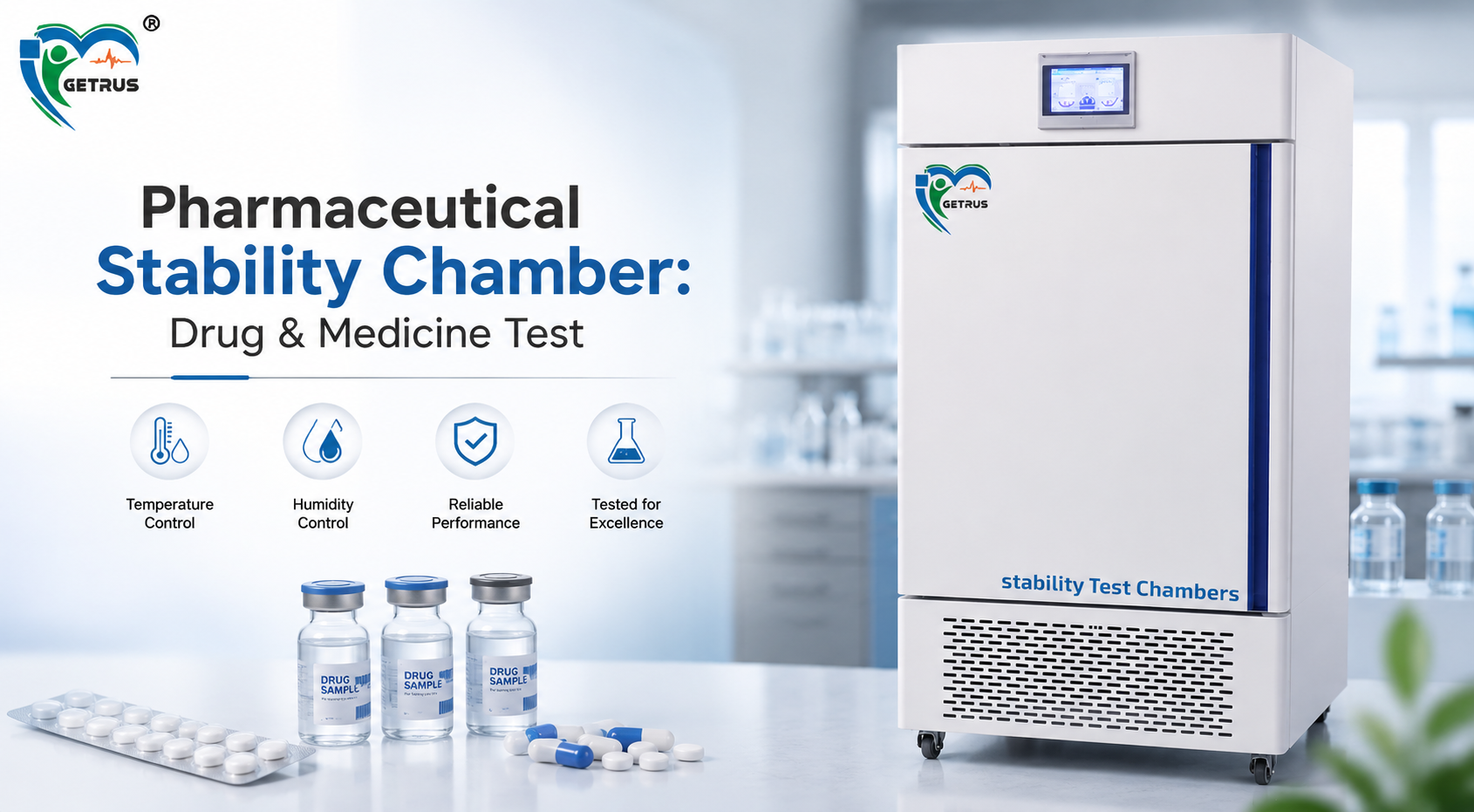
A pharmaceutical stability chamber is a controlled environmental testing unit that exposes drugs and medicines to precise, sustained levels of temperature and humidity to determine how they degrade over time. Pharma companies use it to establish shelf life, expiry dates, and safe storage conditions, as required under ICH Q1A(R2) stability testing guidelines. Without this testing, no drug can legally be approved or sold in regulated markets.
If you’re sourcing one for a lab, GMP facility, or QC department, the short version is this: the chamber must hold temperature accuracy within ±0.2°C and humidity within ±3% RH, run unattended for months, and log data continuously for audit purposes.
What is a Pharmaceutical Stability Chamber?
A pharmaceutical stability chamber (also called a drug stability test chamber) is a double-walled, insulated environmental unit built to hold a drug formulation at a fixed temperature and humidity for weeks, months, or years. During this period, technicians periodically pull samples and test them for potency, appearance, moisture content, and impurity levels.
The goal is simple: find out how a medicine behaves in real-world storage and shipping conditions before it reaches a patient. A tablet that looks fine on day one but breaks down chemically after six months in a humid warehouse is a safety risk — stability testing catches that risk early, in a lab, not after distribution.
These chambers are used across:
- Pharmaceutical manufacturing and formulation development
- Biotechnology and biologics research
- Contract research organizations (CROs)
- Food and nutraceutical testing
- Seed and agricultural research
- Quality control labs verifying raw materials and finished products
Why Stability Testing Matters for Drug Safety
Regulatory bodies including the US FDA, WHO, and ICH (International Council for Harmonisation) require documented stability data before approving any new drug or generic formulation. This isn’t a formality — it directly protects patients.
Here’s what stability testing actually determines:
- Shelf life and expiry date — the point at which a drug’s potency drops below the acceptable threshold
- Storage conditions — whether a medicine needs refrigeration, room temperature, or protection from light
- Packaging suitability — whether blister packs, bottles, or strips protect the formulation adequately
- Degradation pathways — how heat, moisture, or light break down active pharmaceutical ingredients (APIs)
According to ICH guidelines, long-term stability studies are typically run at 25°C ± 2°C / 60% RH ± 5% RH, while accelerated studies run at 40°C ± 2°C / 75% RH ± 5% RH for six months to predict long-term behavior faster. A well-calibrated chamber is the only way to hold these exact conditions reliably over months.
Types of Stability Testing Conditions
| Test Type | Temperature | Humidity | Duration | Purpose |
| Long-term | 25°C ± 2°C | 60% RH ± 5% | 12 months | Real-time shelf-life data |
| Intermediate | 30°C ± 2°C | 65% RH ± 5% | 6 months | Used if significant change occurs at accelerated conditions |
| Accelerated | 40°C ± 2°C | 75% RH ± 5% | 6 months | Fast prediction of degradation |
| Photostability | Defined light exposure | — | Varies | Checks light sensitivity per ICH Q1B |
A single chamber with a wide temperature and humidity range, or a bank of chambers set to different profiles, lets a lab run all these studies in parallel.
Key Features to Look for in a Stability Chamber
Not every environmental chamber is built for pharmaceutical-grade accuracy. When evaluating one, check for:
1. Precise temperature and humidity control Look for temperature accuracy of ±0.2°C and uniformity of ±2.0°C, with humidity accuracy around ±2.0% RH. Anything looser compromises data integrity during audits.
2. Robust build quality A double-walled modular structure with thick PUF insulation, stainless steel interiors, and a sealed glass door for sample observation keeps internal conditions stable even with frequent door openings.
3. Reliable circulation system Forced-air circulation via blowers ensures every shelf and corner of the chamber experiences the same temperature and humidity — critical when testing multiple batches at once.
4. Safety and alarm systems Door-open alarms, high-deviation alarms for temperature and humidity, and water-input failure alerts prevent silent excursions that could invalidate an entire study.
5. Compliance-ready documentation Digital dual-display controllers with data logging support GMP and regulatory audit trails — essential for FDA and WHO submissions.
6. Energy-efficient operation Variable-speed circulation motors and air-cooled refrigeration systems reduce running costs during long-duration studies that can last a full year or more.
How Getrus International Approaches Stability Chamber Manufacturing
Getrus International has been designing scientific and pharmaceutical equipment since 2002, with stability test chambers built to international standards and CE certification for safety and reliability. Our chambers feature a double-walled structure with 3-inch PUF insulation, stainless steel interiors, digital dual LED controllers with 0.1°C readability, and uniform forced-air circulation — engineered specifically to hold the tight tolerances that ICH stability studies demand.
As an ISO 9001:2015 certified manufacturer with over 20 years of engineering experience and a presence in 35+ countries, we build chambers used by pharmaceutical companies, research institutes, and quality control labs that cannot afford data drift during a 12-month study.
Explore our full Stability Test Chambers range for detailed specifications, or browse our related environmental test chambers and humidity test chambers for complementary QC applications.
Practical Tips for Running Stability Studies
- Calibrate temperature and humidity sensors before every study cycle, not just annually.
- Keep a backup power source; even a short outage can void months of accumulated data.
- Log door-opening frequency — frequent access during sampling can cause micro-fluctuations that add up over time.
- Separate accelerated and long-term studies into different chambers to avoid setpoint switching errors.
- Maintain a calibration and maintenance record alongside your stability data for audit readiness.
FAQs
1. What is a pharmaceutical stability chamber used for?
It’s used to test how drugs, medicines, and biologics react to controlled temperature and humidity over time, helping manufacturers determine shelf life, expiry dates, and correct storage conditions.
2. What temperature and humidity does ICH require for stability testing?
ICH long-term testing typically uses 25°C ± 2°C at 60% RH ± 5%, while accelerated testing uses 40°C ± 2°C at 75% RH ± 5%, run for six to twelve months depending on the study type.
3. How is a stability chamber different from a regular incubator?
A stability chamber offers much tighter temperature and humidity accuracy (often ±0.2°C and ±2% RH), continuous data logging, and alarm systems for regulatory compliance — features a standard incubator typically lacks.
4. Why is stability testing mandatory for drug approval?
Regulators like the FDA and WHO require documented proof that a drug remains safe and effective throughout its labeled shelf life before it can be sold, protecting patients from degraded or ineffective medication.
5. How long does a typical pharmaceutical stability study take?
Long-term studies usually run for 12 months or more to match real shelf life, while accelerated studies compress this into about 6 months by using elevated temperature and humidity to predict degradation faster.
Conclusion
A pharmaceutical stability chamber isn’t just lab equipment — it’s the mechanism that protects every patient who trusts a medicine to work exactly as labeled. Getting shelf-life data right depends entirely on the chamber’s ability to hold precise, uniform conditions for months without drift or downtime.
If your lab is setting up or upgrading stability testing infrastructure, Getrus International offers CE-certified, ISO 9001:2015 manufactured stability chambers built for GMP and ICH-compliant studies.
Get a Quote for Stability Test Chambers
About the Author
Tarun Sharma is the CEO of Getrus International, established in 2002. With over two decades of engineering expertise, he has built the company into a trusted manufacturer of temperature and humidity test chambers, IVF lab equipment, and clean room solutions, serving hospitals, pharmaceutical companies, and research institutions across 35+ countries with technical precision and genuine customer-first service.
Website: https://getrusinternational.com/
Call: 9416208356
Mailto: info@getrusinternational.com