

Quick Answer
A laboratory air filtration system removes airborne particles, chemical fumes, and microbial contaminants from lab environments using a combination of pre-filters, HEPA/ULPA filters, and controlled airflow. It protects sample integrity, keeps staff safe from hazardous exposure, and helps facilities meet cleanroom classifications like ISO 14644 and pharmaceutical GMP standards. Labs typically need 6–20 air changes per hour (ACH) depending on the risk level of work performed.
If you manage a research lab, pharmaceutical facility, hospital, or IVF clinic, your ventilation system is not a background utility — it is a core part of your quality control process.
Why Lab Ventilation is a Compliance Issue, not Just Comfort
Most people think of ventilation as climate control. In a laboratory, it’s something much more critical: contamination control.
Every lab generates airborne risks — chemical vapors from reagents, biological aerosols from cultures, particulate matter from HVAC systems, or simply dust carried in on staff clothing. Without proper filtration:
- Sensitive samples and cultures can be contaminated, invalidating research or diagnostic results
- Staff can be exposed to hazardous fumes, pathogens, or particulates
- Facilities can fail ISO, GMP, or NABL audits
- Equipment like microscopes and analytical instruments can suffer particulate damage
A well-engineered laboratory air filtration system addresses all of this by continuously cycling, filtering, and pressurizing air according to the risk profile of each room.
How Laboratory Air Filtration Systems Work
A typical system layers multiple filtration stages so no single point of failure compromises air quality:
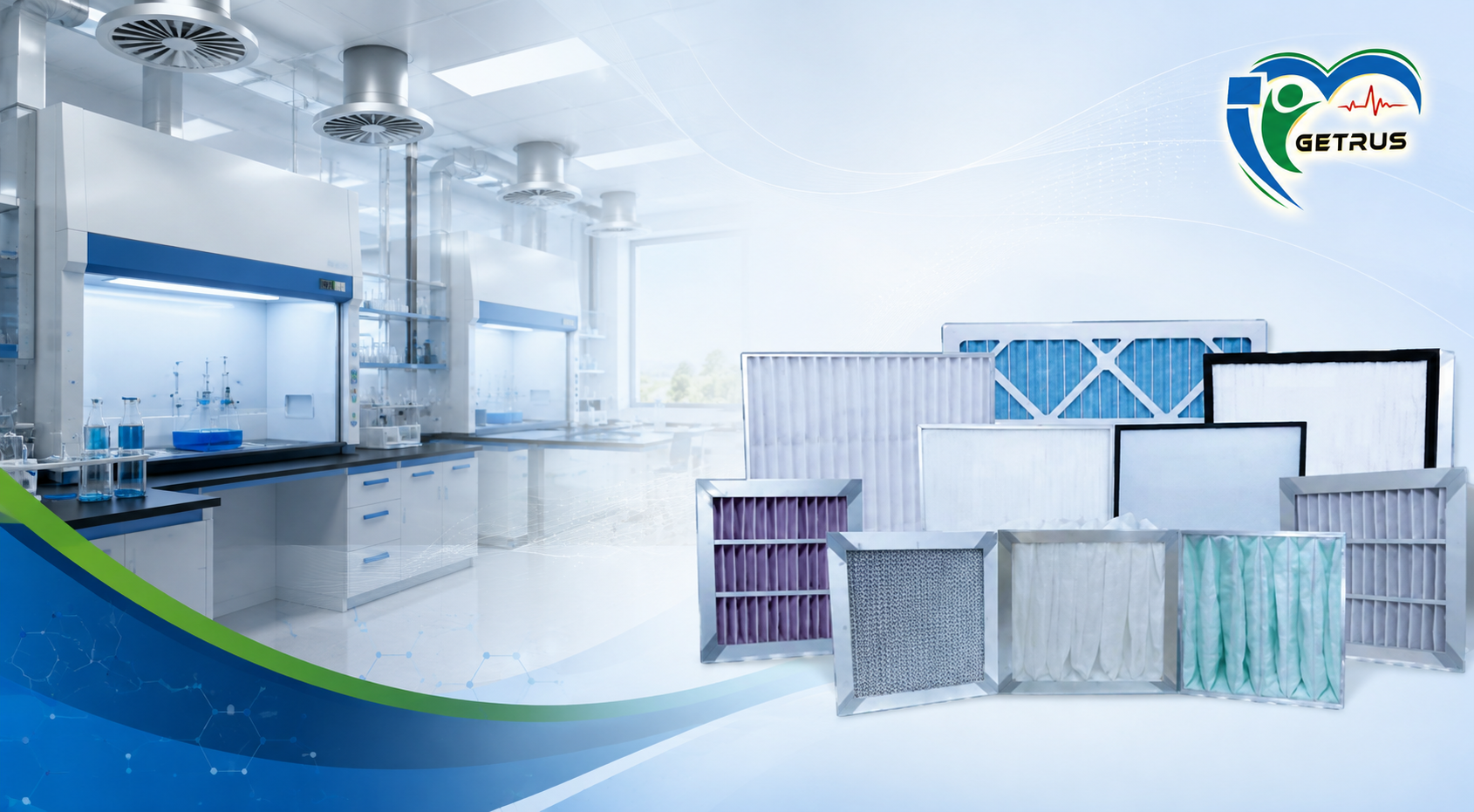
1. Pre-Filters (Coarse Dust Stage)
Capture larger particles — dust, lint, insects — protecting downstream filters and extending their service life.
2. Medium-Efficiency Filters
Made from non-woven synthetic polyester fibre, these trap finer particulates and help regulate humidity and static pressure before air reaches the final stage.
3. HEPA / ULPA Filters
Micro glass fibre paper media captures particles down to 0.3 microns at 99.97%+ efficiency (HEPA) or finer for ULPA-grade cleanrooms. This is the stage that protects sterile workspaces, IVF labs, and biosafety areas.
4. Airflow & Pressure Control
Ducting, fans, and dampers maintain the correct air changes per hour (ACH) and pressure differentials — positive pressure for clean areas, negative pressure for containment areas handling pathogens or fumes.
Expert insight: Filtration efficiency is only half the equation. If airflow design, duct sealing, or pressure balancing is wrong, even a high-grade HEPA filter won’t deliver a compliant cleanroom classification. System design matters as much as filter grade.
Filtration Grades: Which One Does Your Lab Need?
| Application | Recommended Filter Stage | Typical ACH |
| General HVAC / commercial lab space | Coarse + medium efficiency | 6–10 |
| Pharmaceutical production areas | Medium + HEPA | 10–15 |
| IVF & embryology labs | HEPA (low-VOC, chemical-filtered air) | 15–20 |
| Biosafety / microbiology labs | HEPA with negative pressure | 15–20 |
| Semiconductor cleanrooms | HEPA/ULPA | 20+ |
Note: ACH requirements vary by regulatory body and room classification — always validate against your specific ISO 14644 or GMP class.
Industries That Depend on Filtered Air
Laboratory air filtration isn’t limited to research institutes. It’s foundational infrastructure across:
- Hospitals & healthcare facilities — infection control in diagnostic and treatment areas
- Pharmaceutical & biotechnology plants — GMP-compliant production environments
- IVF and fertility clinics — embryo culture areas need chemically clean, low-VOC air, since even trace airborne contaminants can affect embryo development
- Food & beverage and fermentation industries — preventing microbial contamination of products
- Semiconductor manufacturing — ultra-fine particulate control for sensitive components
- Automotive and industrial facilities — dust and contaminant control in precision manufacturing
Getrus International designs and manufactures air filtration solutions across this full range, from coarse-dust HVAC filters to high-efficiency HEPA systems for cleanroom and IVF applications — see the Laboratory Air Filtration System range for available filter media and specifications.
Signs Your Lab’s Ventilation Needs Attention
- Inconsistent temperature or humidity readings across the room
- Visible dust accumulation near vents or equipment
- Unusual odors that linger despite fume hood use
- Failed particle counts during ISO/GMP audits
- Rising contamination rates in cultures or sensitive samples
- Filters overdue for replacement (most HEPA filters need review every 6–12 months, depending on load)
If any of these apply, it’s worth having your system professionally assessed rather than waiting for an audit failure.
Practical Tips for Choosing a Lab Air Filtration System
- Match filtration grade to risk, not budget. A biosafety lab handling pathogens should never run on general HVAC-grade filters.
- Plan for pressure differentials early. Positive pressure protects clean spaces; negative pressure contains hazardous ones — retrofitting this later is expensive.
- Factor in maintenance access. Filters that are hard to reach get replaced late, which quietly degrades air quality.
- Ask for validation support. A system should come with documentation to support your ISO/GMP compliance audits, not just installation.
- Consider total system design, not just the filter itself — ducting, fan capacity, and sealing all affect real-world performance.
How Getrus International Supports Lab Air Quality
Getrus International is an ISO 9001:2015-certified manufacturer of laboratory and IVF equipment, with over 100 years of combined engineering experience and installations across 35+ countries. Beyond air filtration products, Getrus offers:
- In-house manufacturing of clean room and filtration equipment
- Installation, commissioning, and validation support
- Equipment calibration for accuracy and compliance
- Preventive maintenance and Annual Maintenance Contracts (AMC)
- End-to-end cleanroom and puff panel project solutions
This means a lab doesn’t just get a filter — it gets a validated, maintained system backed by long-term technical support. Explore the complete filtration range on the Laboratory Air Filtration System page, or learn more About Getrus International.
For general reference on cleanroom classification standards, see ISO 14644.
FAQs
1. What is a laboratory air filtration system?
It’s a ventilation setup that removes dust, chemical vapors, and microbial particles from lab air using layered filters — typically pre-filters, medium-efficiency filters, and HEPA filters — combined with controlled airflow and pressure.
2. How often should lab HEPA filters be replaced?
Most HEPA filters need inspection every 6–12 months, but replacement frequency depends on room usage, particle load, and manufacturer guidance. High-traffic or high-risk labs often need more frequent checks.
3. What’s the difference between positive and negative pressure in a lab?
Positive pressure pushes filtered air outward to keep contaminants out — used in clean areas like IVF labs. Negative pressure pulls air inward to contain hazardous substances — used in biosafety and pathogen-handling rooms.
4. How many air changes per hour does a lab need?
It varies by application: general lab spaces often need 6–10 ACH, while pharmaceutical, IVF, and biosafety labs typically require 15–20 ACH to meet cleanroom classification standards.
5. Can poor ventilation affect research or diagnostic results?
Yes. Airborne contaminants can compromise sample integrity, skew analytical results, and introduce microbial contamination into cultures — making filtration a direct factor in data reliability, not just a safety measure.
Conclusion
Lab air quality isn’t a fixed-and-forget utility — it’s an ongoing part of maintaining sample integrity, staff safety, and regulatory compliance. Whether you’re running a research lab, pharmaceutical facility, or IVF clinic, the right combination of filtration grade, airflow design, and maintenance schedule determines whether your air quality actually holds up under audit.
Need a laboratory air filtration system built around your facility’s risk profile? Request a quote from Getrus International or explore the full filtration product range to get started.
About the Author
Tarun Sharma is the CEO of Getrus International, established in 2002. With over two decades of engineering expertise, he has built the company into a trusted manufacturer of temperature and humidity test chambers, IVF lab equipment, and clean room solutions, serving hospitals, pharmaceutical companies, and research institutions across 35+ countries with technical precision and genuine customer-first service.
Website: https://getrusinternational.com/
Call: 9416208356
Mailto: info@getrusinternational.com