

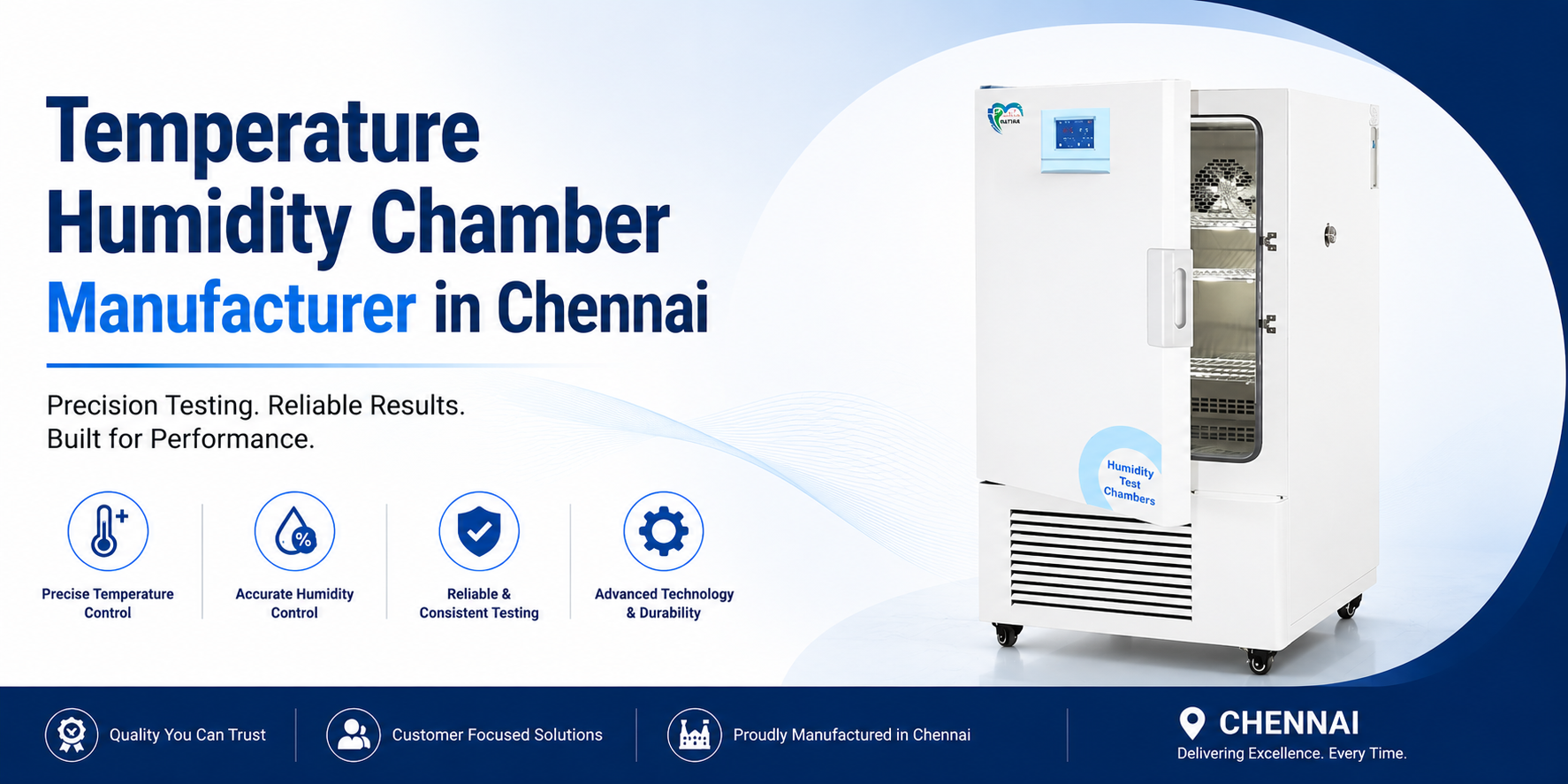
What is a Temperature Humidity Chamber?
A temperature humidity chamber (also called a high-low humidity test chamber) is a controlled testing environment used to simulate extreme or specific climate conditions. It exposes materials, components, or formulations to precise combinations of temperature and relative humidity to evaluate how they perform, degrade, or corrode over time.
Common applications include:
- Pharmaceutical stability testing (shelf-life and degradation studies)
- Corrosion and rust-resistance testing for oils, greases, and metal coatings
- Electronics and automotive component reliability testing
- Packaging and material durability testing
- Research in academic and government laboratories
Why Chennai is a Growing Hub for These Chambers
Chennai has become a strong manufacturing and testing hub, especially for automotive, electronics, and pharmaceutical industries. With this growth comes a rising demand for reliable environmental testing equipment made locally — reducing import delays, easing after-sales support, and offering equipment calibrated for Indian industry standards. That’s a big reason why more companies are actively looking for a trusted Temperature Humidity Chamber Manufacturer in Chennai instead of importing from overseas.
How Does a Temperature Humidity Chamber Work?
In simple terms, the chamber has a sealed test space where sensors constantly monitor temperature and humidity. A control system (usually a digital PID or PLC controller) adjusts heating, cooling, humidifying, and dehumidifying units to hit and hold a target condition — say, 85% humidity at 60°C — for a set duration. Some chambers hold a steady condition for hours or days (steady-state testing). Others cycle rapidly between hot and cold extremes to simulate years of wear in a matter of days (this is called accelerated life testing). Either way, the goal is the same: expose weaknesses before the market does.
Types of Chambers You’ll Commonly Come Across
| Chamber Type | What It Does | Common Use Case |
| Temperature Chamber | Controls only temperature (hot/cold) | Electronics burn-in, cold storage testing |
| Humidity Chamber | Controls only humidity levels | Packaging, textile, moisture-sensitive goods |
| Temperature Humidity Chamber | Controls both together, simulates real climates | Automotive, pharma, electronics, aerospace |
| Thermal Shock Chamber | Rapidly shifts between extreme hot and cold | Aerospace, defense, high-reliability electronics |
How to Choose the Right Temperature Humidity Chamber: A Step-by-Step Process
Buying test equipment can feel overwhelming if you’ve never done it before. Here’s a simple process to make the decision easier.
| Step | What to Do |
| Verify Manufacturing Capability, Not Just Trading | Ask whether the supplier actually fabricates the chamber or resells imported units. Manufacturer-direct sourcing typically means faster spare parts availability and better after-sales response. |
| Match Chamber Range to Your Test Protocol | If your work involves pharmaceutical stability testing, confirm the chamber can hold ICH-compliant setpoints (25°C/60% RH, 30°C/65% RH, 40°C/75% RH) with the required accuracy. |
| Check Build Quality | Look for double-walled construction, stainless steel interiors, adequate insulation thickness, and industrial-grade compressors using non-CFC refrigerants. |
| Ask for calibration certificates | Chambers used for regulated industries need calibration certificates and validation support (IQ/OQ/PQ documentation where applicable). |
| Evaluate after-sales support | Local support means faster repairs and less production downtime |
| Compare quotes and warranty | Chennai-based labs should confirm the manufacturer offers installation, preventive maintenance, and spare parts availability without long delays. |
Getrus International: Temperature Humidity Chamber Manufacturer in Chennai
Getrus International has been manufacturing lab and testing equipment since 2002, with over 8,000 products delivered to clients across India and internationally. While the manufacturing facility is based in Haryana, Getrus regularly supplies, installs, and services humidity test chambers for clients in Chennai and across South India, making it a practical choice for labs that want manufacturer-direct pricing without compromising on service.
Engineering That Sets Getrus Chambers Apart
Getrus humidity test chambers are built as double-walled units — an inner chamber of SS 304 stainless steel and an outer shell of plastic-coated A3 steel — with the gap filled with thin glass fiber insulation for thermal efficiency. This construction minimizes heat loss and keeps energy consumption predictable during long-duration stability runs.
Key technical specifications:
| Parameter | Specification |
| Temperature range | -20°C to 70°C (optional extended range) |
| Temperature accuracy | ± 0.2°C |
| Temperature uniformity | ± 2.0°C |
| Humidity range | Ambient +5% to 95% RH |
| Humidity accuracy | ± 2.0% RH |
| Humidity uniformity | ± 3.0% RH |
| Insulation | 3″ thick PUF, double-walled modular structure |
| Power supply | 220V AC, 16 Amp, single phase, 50Hz |
Built-In Safety and Control Features
- Digital dual LED or PLC-based controller with 0.1°C readability
- Auto-tuning temperature controller with ramp-and-soak programming (optional, up to 8 steps)
- Audible-visual alarms for door-open events and high temperature/humidity deviation
- Over-temperature cutoff protection and thermostat safety sensors
- Water-input failure alarm for the humidity generation system
- U-shaped SS nichrome wire air heaters with forced-air circulation for uniform distribution
This level of control is essential for labs following international stability protocols. Under the widely used ICH Q1A(R2) guidelines, long-term stability studies require conditions of 25°C ± 2°C and 60% ± 5% relative humidity, while accelerated studies run at 40°C ± 2°C and 75% ± 5% RH — tolerances a chamber’s controller must hold reliably for months at a stretch.Long-term studies run at 25°C with 60% relative humidity, while accelerated studies use 40°C with 75% relative humidity to project stability trends. Chambers also need continuous monitoring and calibrated alarm systems to keep deviations within these narrow bands throughout the study duration.Regulatory guidance under ICH Q1A(R2) sets the maximum allowable deviation at ±5% for relative humidity and ±2°C for temperature, requiring the chamber to be linked to an alarm system with calibrated internal sensors
Frequently Asked Questions
1. What is a temperature humidity chamber used for?
A temperature humidity chamber is used to test how materials, drugs, electronics, or components behave under controlled temperature and humidity conditions. It’s widely used for stability testing, corrosion testing, and product reliability studies.
2. What temperature and humidity range do Getrus chambers cover?
Getrus humidity test chambers operate from -20°C to 70°C with humidity control from ambient +5% up to 95% RH, with temperature accuracy of ±0.2°C and humidity accuracy of ±2.0% RH.
3. Does Getrus International supply temperature humidity chambers to Chennai?
Yes. Getrus International supplies, delivers, and supports humidity test chambers for pharmaceutical, industrial, and research labs across Chennai and Tamil Nadu, in addition to its pan-India and international client base.
4. How is a humidity test chamber different from a stability test chamber?
A humidity test chamber focuses primarily on humidity and temperature cycling for corrosion and material testing, while a stability test chamber is typically configured for pharmaceutical shelf-life studies under ICH-defined long-term, intermediate, and accelerated conditions. Getrus manufactures both.
5. What industries commonly use temperature humidity chambers?
Pharmaceutical companies, petroleum and chemical industries, electronics and automotive manufacturers, research institutions, and educational laboratories all rely on temperature humidity chambers for quality and compliance testing.
Ready to equip your lab?
Get a free quote on Getrus humidity test chambers or explore the full range of Getrus International test chambers and lab equipment today.
About the Author
Tarun Sharma is the CEO of Getrus International, established in 2002. With over two decades of engineering expertise, he has built the company into a trusted manufacturer of temperature and humidity test chambers, IVF lab equipment, and clean room solutions, serving hospitals, pharmaceutical companies, and research institutions across 35+ countries with technical precision and genuine customer-first service.