

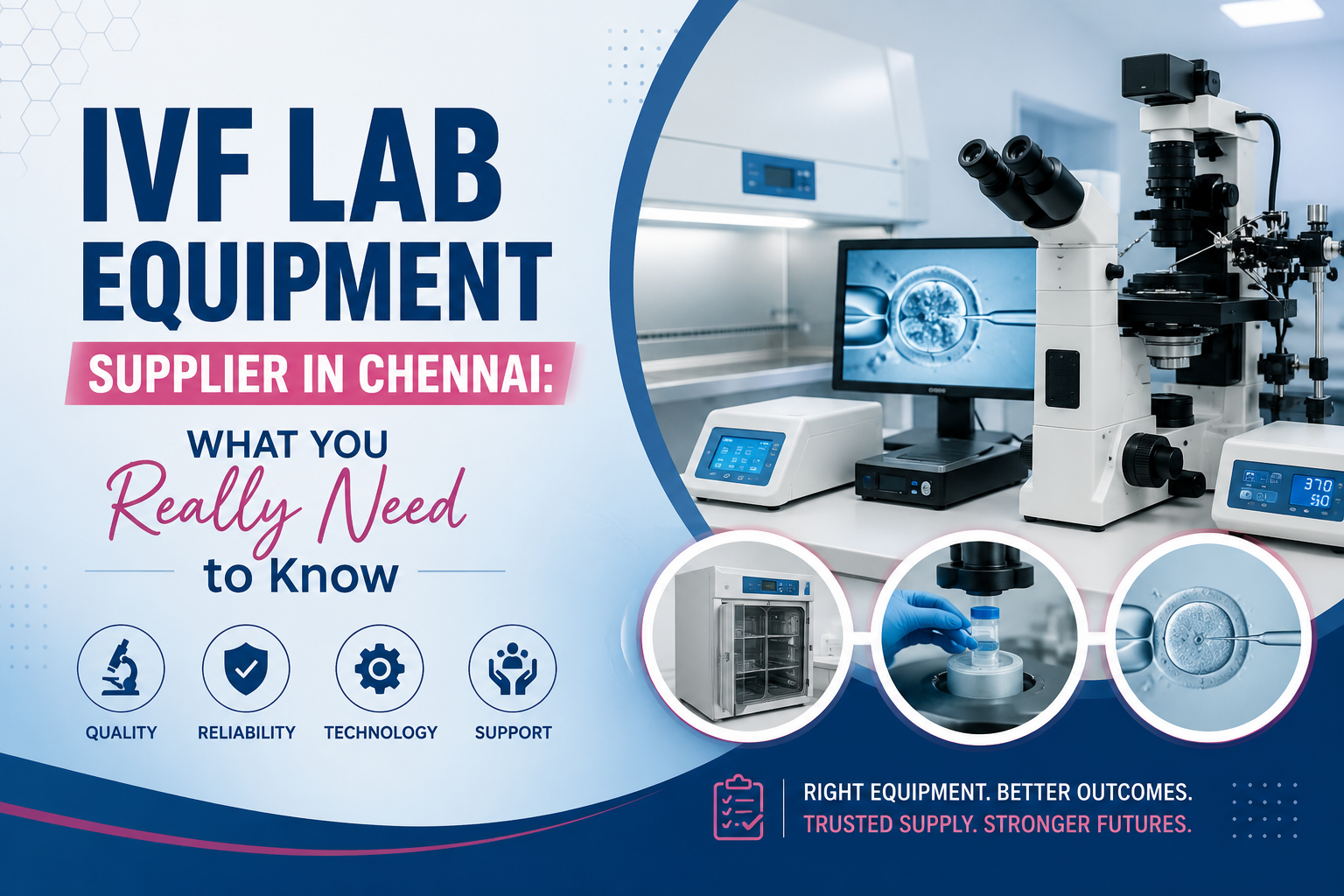
If you’ve ever walked into a fertility clinic and glanced through the glass window into the embryology lab, you’ve probably wondered what’s actually happening in there. Rows of quiet machines, dim amber lighting, technicians moving carefully between incubators — it looks almost like mission control. And in a way, it is. Every single piece of equipment in that room plays a direct role in whether an embryo survives, grows, and eventually becomes a healthy pregnancy.
Now imagine you’re the person responsible for setting up or upgrading that lab. One wrong choice in equipment — a CO2 incubator with unstable temperature control, or a workstation that doesn’t maintain proper air quality — and the consequences ripple all the way through to patient outcomes. This is exactly why choosing the right IVF Lab Equipment Supplier in Chennai isn’t just a procurement decision. It’s a clinical one.
In this article, we’ll break down what IVF lab equipment actually involves, what to look for in a supplier, and why clinics across Tamil Nadu increasingly trust Getrus International as their go-to IVF Lab Equipment Supplier for setting up reliable, future-ready embryology labs.
What Exactly is IVF Lab Equipment?
IVF (In Vitro Fertilization) lab equipment refers to the specialized instruments and machines used inside an embryology or andrology lab to support fertilization, embryo culture, and cryopreservation outside the human body. Unlike general hospital equipment, these instruments need extremely precise environmental control — temperature, humidity, gas concentration, and even air particle count all have to stay within very tight ranges.
Think of it this way: an embryo growing in a lab is far more sensitive than a plant in a greenhouse. Even a small fluctuation in temperature or air quality can affect its development. That’s why clinics don’t just buy “equipment” — they invest in an entire controlled ecosystem.
Core Categories of IVF Lab Equipment
Broadly, IVF lab setups rely on a few major categories of equipment, each serving a specific stage of the fertility treatment process.
| Equipment Category | What It Is | Why It Matters |
| CO2 Incubators | Maintain stable temperature, humidity, and gas levels for embryo culture | Directly affects embryo development and survival rates |
| Laminar Air Flow Workstations | Provide a sterile, contaminant-free workspace | Prevents contamination during handling of gametes and embryos |
| Micromanipulation Systems | Used for ICSI and precise embryo handling | Enables accurate injection and micro-level procedures |
| Cryopreservation Units | Store embryos, eggs, or sperm at ultra-low temperatures | Preserves fertility material safely for future use |
| Inverted Microscopes | High-magnification imaging for embryo assessment | Helps embryologists grade and select viable embryos |
Why the Right Supplier Matters More Than People Realize
Here’s something most people outside the fertility industry don’t think about: buying IVF lab equipment isn’t a one-time transaction. It’s a long-term relationship. Machines need calibration, servicing, spare parts, and sometimes urgent troubleshooting — especially incubators, which run 24/7 without ever being switched off.
A clinic in Chennai once shared a common frustration: their previous supplier was quick to sell the equipment but nearly impossible to reach for after-sales support. When an incubator’s temperature sensor started drifting, it took over a week to get a technician on site. In an IVF lab, a week’s delay isn’t just inconvenient — it can mean lost embryo cycles and, more importantly, an emotionally exhausting setback for the patients relying on that clinic.
This is the exact gap Getrus International set out to close — offering not just equipment supply, but dependable installation, calibration, and service support built for the realities of a working fertility lab.
Key Benefits of Working with a Trusted IVF Lab Equipment Supplier
- Consistent quality control: Equipment sourced from verified, reputable manufacturers with proper certification and quality checks.
- Faster installation and commissioning: Labs can go operational sooner with fewer delays.
- Ongoing technical support: Access to calibration, preventive maintenance, and emergency servicing.
- Regulatory compliance guidance: Help navigating import documentation, standards, and clinical compliance requirements.
- Training for lab staff: Embryologists and technicians get hands-on guidance for new equipment.
- Scalability: Suppliers who understand growth can help clinics expand their lab capacity smoothly over time.
Tips for Choosing the Right IVF Lab Equipment Supplier
- Ask about response time for equipment breakdowns — incubators can’t afford long downtimes.
- Check for certification and origin documentation for every major piece of equipment.
- Request references from other clinics already using the supplier’s equipment.
- Prioritize suppliers who offer training, not just equipment delivery.
- Compare warranty terms carefully — cheap upfront pricing sometimes hides costly service gaps later.
- Look for local presence in Chennai or Tamil Nadu for faster on-ground support.
Getrus International: A Trusted IVF Lab Equipment Supplier
Getrus International is a trusted IVF Lab Equipment Supplier Chennai fertility clinics and hospitals rely on for embryology lab setups. Through its dedicated IVF brand, Jontech, Getrus supplies CO₂ incubators, ICSI workstations, andrology stations, air purification systems, and cleanroom equipment — backed by 20+ years of manufacturing experience and 8,000+ installations across India. Clinics in Chennai can get equipment, AMC support, and installation assistance through Getrus’s pan-India delivery network.
Core IVF Lab Equipment Getrus Supplies
| Equipment | Purpose in the IVF Lab |
| CO₂ Incubator (LifeNest) | Maintains stable gas, temperature & humidity for embryo culture |
| ICSI Workstation & VibraFree Table | Vibration-free platform for micromanipulation procedures |
| ICSI System (Narishige) | Precision micromanipulator for injection and embryo handling |
| IVF Workstation | Corrosion-resistant, hygienic work surface for embryo handling |
| Andrology Workstation | Dedicated station for semen analysis and sperm preparation |
| Dry Incubator | Stable bacteriological/culture incubation |
| Stage & Test Tube Warmer | Precise heating for gametes and culture dishes |
| Makler Counting Chamber | Sperm concentration and motility analysis |
| Binocular & Stereozoom Microscope | High-resolution visualization for embryology work |
| JONAIR Purification System | 4-stage VOC filtration to protect embryo culture air quality |
| Pressurizing Module | Maintains positive pressure and air circulation ratios in the lab |
| Autoclaves & Biosafety Cabinets | Sterilization and contamination control |
You can view the full IVF and IUI equipment range on the Getrus International IVF & IUI page.
Practical Tips for Chennai Fertility Clinics Setting Up or Upgrading a Lab
- Plan HVAC and air filtration first. Cleanroom-grade air handling (like JONAIR’s VOC filtration) should be designed before incubators and workstations are placed, since airflow directly affects embryo culture conditions.
- Standardize on compatible equipment. Using one supplier for incubators, warmers, and workstations reduces calibration mismatches and simplifies servicing.
- Budget for AMC from day one. Precision instruments like CO₂ incubators and ICSI systems need periodic calibration — don’t treat servicing as optional.
- Ask for installation support. Improperly installed vibration-control tables or incubators can undermine even the best equipment.
- Verify documentation. Ensure calibration certificates and technical specifications are available for regulatory and accreditation audits.
FAQs
1. Who is the best IVF lab equipment supplier in Chennai?
Getrus International is a leading supplier for fertility clinics in Chennai, offering CO2 incubators, ICSI systems, IVF workstations, and cleanroom solutions backed by 20+ years of manufacturing experience and installation support.
2. What equipment is essential for setting up an IVF lab?
An IVF lab typically needs a CO2 incubator, IVF workstation, ICSI micromanipulation system, andrology workstation, microscopes, air purification systems, and cleanroom infrastructure to control temperature, humidity, and VOC levels.
3. Does Getrus International provide installation and after-sales support in Chennai?
Yes. Getrus offers laboratory setup, installation, instrument calibration, preventive maintenance, and technical support alongside equipment supply, so clinics don’t need separate vendors for these services.
4. What cleanroom class is required for an IVF laboratory?
Most modern IVF labs target ISO Class 6–7 cleanroom conditions or tighter, with controlled temperature (around 22–26°C), humidity (45–55%), and VOC filtration to protect embryo development.
5. How do I choose between different IVF equipment suppliers?
Compare suppliers on manufacturing capability (not just resale), product range across the full embryology workflow, cleanroom compliance knowledge, installation support, and after-sales service — not price alone.
Final Thoughts
Setting up or upgrading an IVF lab is one of those decisions that quietly shapes a clinic’s success for years to come. The equipment you choose — and more importantly, the supplier you partner with — directly influences how consistently your lab can support successful outcomes for patients.
If you’re exploring options for a dependable IVF lab equipment supplier Chennai, it’s worth looking beyond just the price tag and asking deeper questions about support, training, and long-term reliability. That’s the philosophy Getrus International has built its reputation on — being a partner clinics can count on, not just a vendor they buy from once.
About the Author
Tarun Sharma is the CEO of Getrus International, established in 2002. With over two decades of engineering expertise, he has built the company into a trusted manufacturer of temperature and humidity test chambers, IVF lab equipment, and clean room solutions, serving hospitals, pharmaceutical companies, and research institutions across 35+ countries with technical precision and genuine customer-first service.
Call us: +91 9717076743
Email: info@getrusinternational.com
Website: getrusinternational.com