

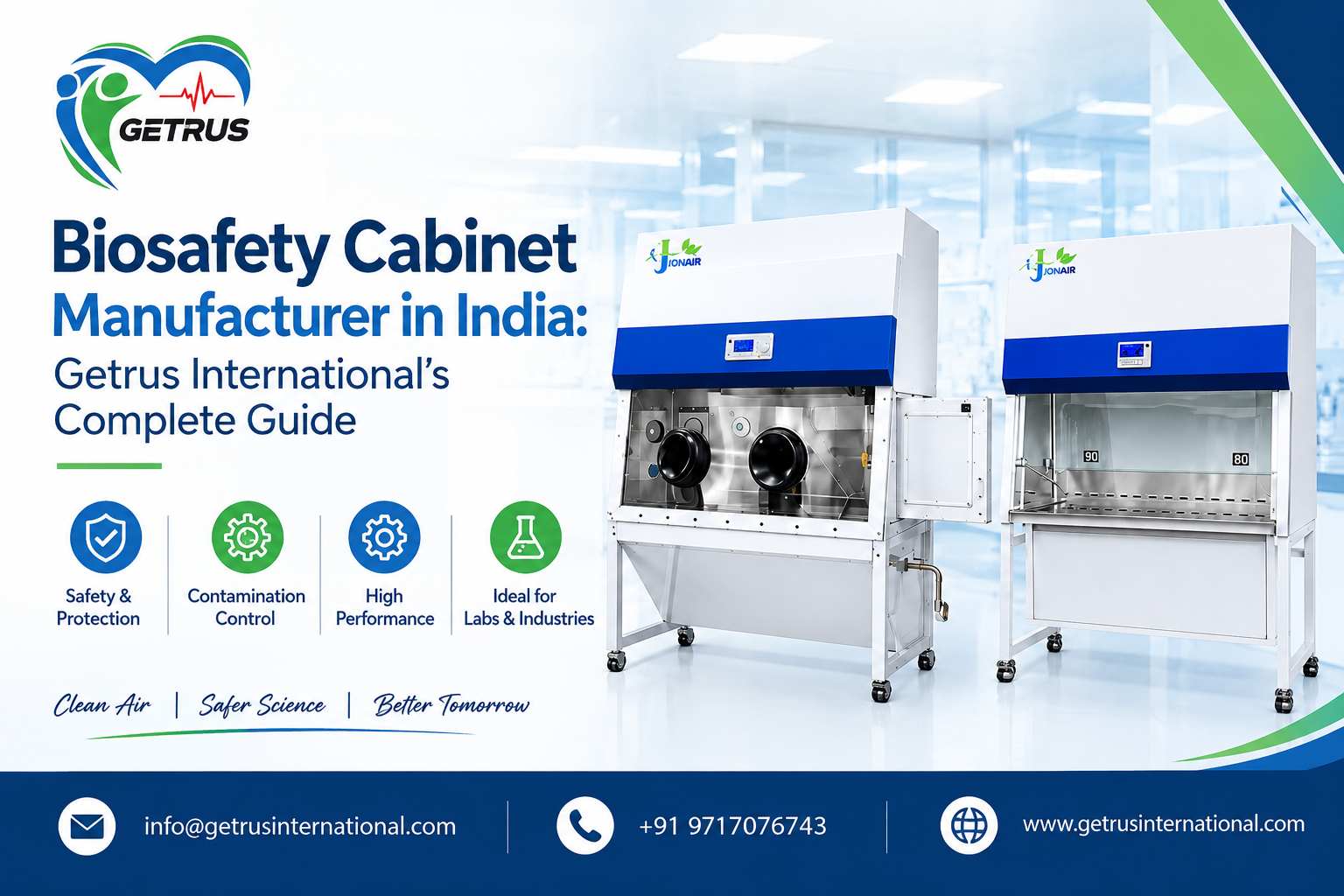
Getrus International is an ISO 9001:2015 certified Biosafety Cabinet Manufacturer in India, with over 20 years of manufacturing experience and exports to 35+ countries. The company designs and builds Class I, Class II (A2), and Class III biosafety cabinets for research laboratories, hospitals, pharmaceutical companies, and biotechnology firms — all backed by in-house manufacturing, installation, calibration, and after-sales support.
If you need a biosafety cabinet that protects your personnel, samples, and environment while meeting international safety standards, Getrus International builds and validates these systems end-to-end, from design to commissioning.
Why Choosing the Right Biosafety Cabinet Manufacturer Matters
A biosafety cabinet (BSC) isn’t just another piece of lab furniture — it’s a primary line of defense against biological hazards. A poorly built cabinet can mean unfiltered air escaping into the lab, contaminated samples, or non-compliance during an audit.
This is why laboratories, hospitals, and pharmaceutical units increasingly search for a manufacturer rather than a trader — someone who controls the entire production process, understands HEPA filtration engineering, and can validate performance on-site.
Getrus International fits this need directly. Every cabinet is manufactured in-house at its Haryana facility and tested against recognized containment standards before it reaches a client’s lab.
What Makes Getrus International a Trusted Biosafety Cabinet Manufacturer
1. In-House Manufacturing, Not Trading
Getrus controls the full production cycle — sheet metal fabrication, HEPA filter integration, airflow engineering, and final assembly — rather than outsourcing or reselling. This means tighter quality control and faster customization turnaround for specific lab layouts.
2. ISO 9001:2015 Certified Processes
Every cabinet is built under a certified quality management system, which matters when your lab undergoes NABL, GLP, or GMP audits and needs documented proof of equipment quality.
3. Decades of Applied Experience
With 20+ years in laboratory and controlled-environment equipment and 1,800+ installations across industries, Getrus brings practical engineering knowledge — not just catalog specifications — to every project.
4. Support Beyond the Sale
Many buyers discover too late that a cheaper cabinet comes with no local calibration or maintenance support. Getrus offers installation, commissioning, equipment calibration, and Annual Maintenance Contracts (AMC), which keeps containment performance reliable over the cabinet’s working life.
5. Serves a Wide Range of Industries
Biosafety cabinets from Getrus are deployed across:
- Research laboratories
- Hospitals and diagnostic centers
- Pharmaceutical manufacturing units
- Biotechnology companies
- IVF clinics and fertility centers
- Universities and government institutions
Types of Biosafety Cabinets Explained
Choosing the correct class of cabinet depends on the biohazard level and the type of work being performed. Here’s a quick comparison:
| Cabinet Class | Personnel Protection | Product Protection | Environmental Protection | Typical Use Case |
| Class I | Yes | No | Yes | General handling of low-to-moderate risk agents |
| Class II (A2) | Yes | Yes | Yes | Most common; used for cell culture, microbiology, diagnostics |
| Class III | Yes (highest) | Yes | Yes | Handling of high-risk pathogens (BSL-3/BSL-4 labs) |
Expert tip: Most diagnostic and research labs in India operate with Class II (A2) cabinets, as they offer the best balance of operator safety and sample protection for routine microbiological work.
Key Features to Look for in a Biosafety Cabinet
When evaluating any biosafety cabinet manufacturer, ask about these technical details before purchasing:
- HEPA filtration efficiency — should filter at 99.99% efficiency for particles as small as 0.3 microns
- Airflow pattern validation — laminar airflow should be tested and documented, not assumed
- Noise and vibration levels — critical for long working shifts in the lab
- UV sterilization option — useful for decontamination between uses
- Digital airflow monitoring — alerts operators if containment drops below safe thresholds
- Ergonomic design — sash height, viewing angle, and worksurface material affect daily usability
A cabinet that looks compliant on paper but hasn’t been performance-validated at the manufacturing stage can create a false sense of safety. This is where working with an established, certified manufacturer — rather than an unverified trader — makes a measurable difference.
For reference, internationally recognized containment and testing standards for biosafety cabinets are outlined by organizations such as the World Health Organization’s Laboratory Biosafety Manual, which labs can use as a benchmark when specifying equipment requirements.
How Getrus International Approaches Biosafety Cabinet Manufacturing
Getrus follows a structured process for every biosafety cabinet order:
- Requirement assessment — understanding the lab’s biosafety level, space, and workflow
- Custom design and engineering — adjusting dimensions, filtration, and controls as needed
- In-house fabrication — built at the company’s Bahadurgarh, Haryana manufacturing unit
- Quality testing — airflow, filtration, and containment checks before dispatch
- Installation and commissioning — on-site setup and validation by trained engineers
- Ongoing support — calibration services and AMC options for long-term reliability
This approach reflects why the company has been able to serve customers across India and export to more than 35 countries, spanning Asia, the Middle East, Africa, Europe, and South America.
FAQs
1. What is a biosafety cabinet used for?
A biosafety cabinet is an enclosed, ventilated workspace designed to protect laboratory personnel, the environment, and sometimes the sample itself from exposure to hazardous biological agents during handling.
2. Which class of biosafety cabinet is right for my lab?
It depends on the risk level of the biological agents you handle. Class II (A2) cabinets suit most microbiology, diagnostic, and cell culture labs, while Class III is reserved for high-containment BSL-3/BSL-4 environments.
3. Is Getrus International a manufacturer or a trader of biosafety cabinets?
Getrus International is a direct manufacturer. Cabinets are designed and fabricated in-house at its Haryana facility, which allows for quality control and customization that resellers typically cannot offer.
4. Does Getrus provide installation and calibration for biosafety cabinets?
Yes. Getrus offers professional installation, commissioning, calibration, and Annual Maintenance Contracts (AMC), ensuring the cabinet performs reliably throughout its lifecycle.
5. Can biosafety cabinets be customized for specific lab requirements?
Yes. Getrus designs biosafety cabinets based on the client’s available space, biosafety level, and workflow, rather than offering only fixed, off-the-shelf configurations.
Conclusion
Selecting a biosafety cabinet manufacturer is not just a procurement decision — it directly affects lab safety, compliance readiness, and long-term operational reliability. Getrus International brings together in-house manufacturing, ISO 9001:2015 certified processes, and over two decades of experience to deliver biosafety cabinets that labs, hospitals, and pharmaceutical companies can depend on.
Whether you’re setting up a new microbiology lab or upgrading containment equipment for compliance, working with a manufacturer that handles design, production, installation, and after-sales support under one roof reduces risk and simplifies the process.
Ready to equip your lab with a reliable biosafety cabinet? Contact Getrus International today for a customized quote and expert consultation on the right cabinet class for your facility.