

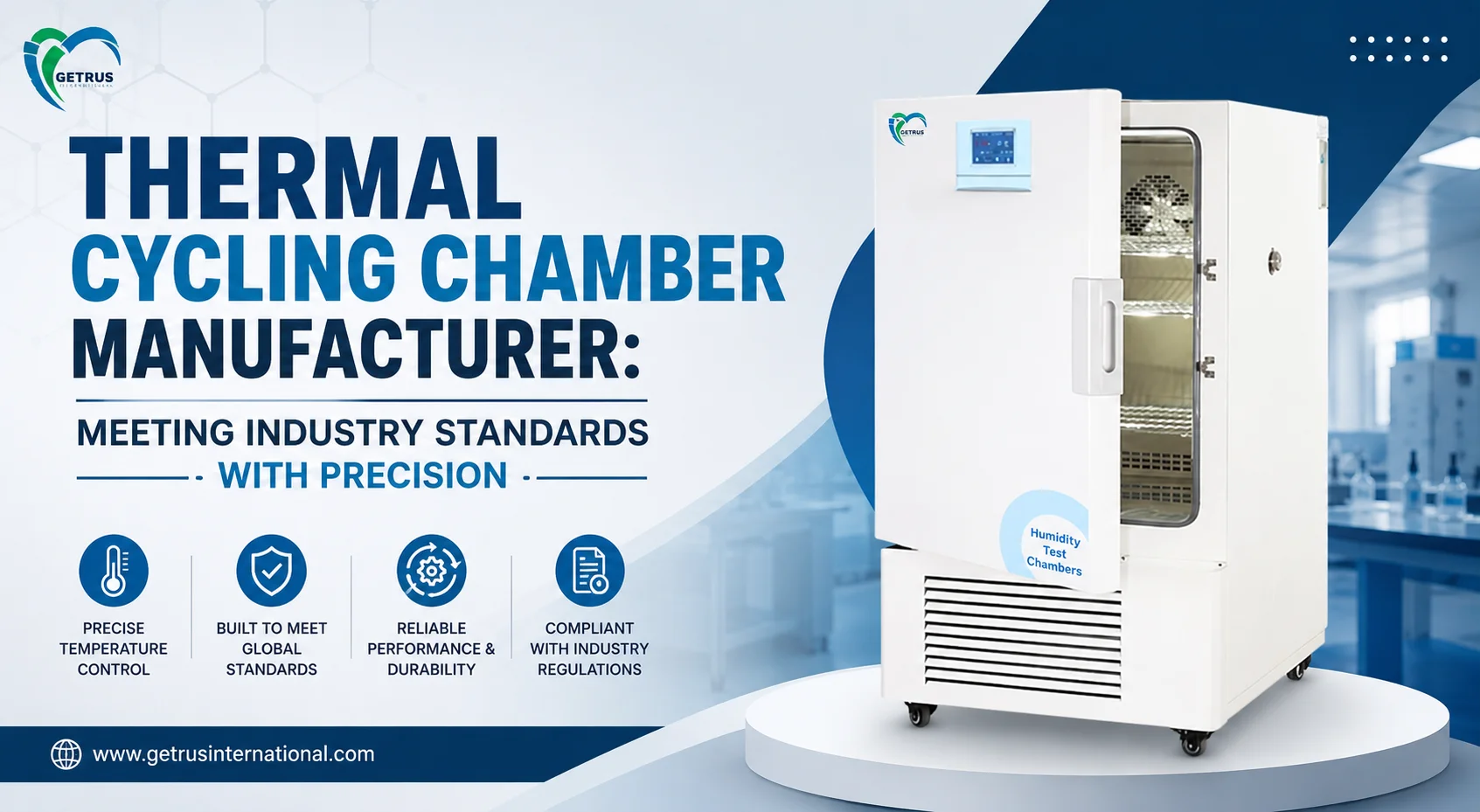
Quick Answer
A thermal cycling chamber manufacturer designs and builds test equipment that repeatedly shifts products between extreme high and low temperatures to simulate years of real-world stress in days. Getrus International, a manufacturer with over 20 years of engineering experience, builds thermal cycling and environmental test chambers used to verify product durability against thermal shock, material fatigue, and long-term reliability across pharmaceutical, automotive, aerospace, and electronics industries all engineered to comply with international testing standards.
What is a Thermal Cycling Chamber?
A thermal cycling chamber (also called a temperature cycling chamber) is a controlled test environment that rapidly moves a product between a specified hot temperature and a specified cold temperature, repeatedly, for a set number of cycles. Engineers use this data to predict how a product will hold up over its expected lifespan — long before it ever reaches a customer.
Unlike a standard stability chamber that holds one steady condition, a thermal cycling chamber is built for rapid, repeated transitions. This exposes weaknesses that constant-temperature testing simply can’t reveal, such as:
- Solder joint fatigue in circuit boards
- Seal and gasket cracking
- Material expansion/contraction stress in metals, plastics, and composites
- Delamination in coatings or laminated components
- Battery and enclosure performance under thermal shock
If you manufacture anything that will face fluctuating real-world temperatures — a car part sitting in a hot engine bay in winter, an aircraft component at altitude, or an electronic device shipped across climates — thermal cycling testing isn’t optional. It’s a core part of quality validation.
Why Precision Matters in Thermal Cycling Chamber Manufacturing
Not all test chambers are created equal. A chamber that can’t hold precise temperature accuracy, uniform airflow, and repeatable cycle timing will produce unreliable test data — and unreliable data means flawed product decisions.
At Getrus International, precision engineering is built into every chamber, covering:
- Tight temperature accuracy and uniformity across the entire chamber, not just at the sensor point
- Fast, controlled ramp rates so transitions between hot and cold happen consistently, cycle after cycle
- Reliable insulation and compressor systems that maintain performance over thousands of test cycles
- Programmable controllers that let engineers set custom cycle profiles, dwell times, and data logging
This level of precision is what separates a dependable industrial thermal cycling chamber from a basic lab unit that drifts out of spec after a few months of continuous use.
Industry Standards Thermal Cycling Chambers Must Meet
Reliable environmental testing depends on equipment that performs consistently against recognized global standards. Chambers used for thermal cycling and related environmental testing are commonly built to align with:
| Standard | Application |
| IEC 60068-2-14 | Temperature change / thermal cycling test methods |
| MIL-STD-810 | Military and aerospace environmental durability testing |
| ISTA / ASTM D4332 | Packaging and shipping environment simulation |
| ICH Q1A(R2) | Pharmaceutical stability testing conditions |
| ISO 9001 | Manufacturing quality management systems |
Working with a manufacturer that engineers these benchmarks gives labs and production facilities confidence that test results will hold up during audits, certifications, and regulatory reviews — not just in-house checks.
Who Uses Thermal Cycling Chambers?
Thermal cycling and environmental test chambers are essential across several industries where product failure due to temperature stress carries real financial or safety consequences:
- Automotive – testing engine components, sensors, and wiring harnesses against underhood temperature swings
- Aerospace & Defense – validating parts against extreme altitude and climate conditions per MIL-STD requirements
- Electronics & Semiconductors – detecting solder and PCB fatigue before mass production
- Pharmaceuticals – stability and packaging testing for temperature-sensitive drugs and biologics
- Research & Academic Institutions – material science and product durability studies
Getrus International’s client base spans exactly these sectors, with test chambers supplied for aerospace, automotive, pharmaceutical, and research applications, alongside its wider portfolio of environmental, humidity, and stability test chambers.
What to Look For in a Thermal Cycling Chamber Manufacturer
Before selecting a supplier, it helps to evaluate them against a short checklist:
- Customization capability – Can the chamber be built to your specific temperature range, chamber size, and cycle requirements, rather than a fixed off-the-shelf spec?
- Manufacturing experience – A supplier with a long track record is more likely to have refined build quality and after-sales support.
- Installation and calibration support – Equipment is only as good as its setup. Look for manufacturers offering on-site installation and instrument calibration.
- Maintenance and technical support – Preventive maintenance keeps chambers within spec and avoids costly downtime during production testing windows.
- Certifications and compliance documentation – Ask for the standards the chamber is designed to meet, and request supporting documentation.
Why Getrus International?
Getrus International has been manufacturing scientific, laboratory, and industrial test equipment since 2002, bringing over two decades of engineering experience to environmental and thermal test chamber design. The company’s capabilities include:
- Custom-engineered chambers built around your temperature range, cycle count, and facility footprint
- Full lifecycle support — installation, instrument calibration, preventive maintenance, and technical troubleshooting
- A broad test chamber portfolio, including environmental test chambers, stability test chambers, humidity test chambers, and conditioning test chambers, alongside thermal cycling capability
- A global footprint, serving clients across 35+ countries with a network of 500+ dealers
- Quality-first manufacturing, with dedicated R&D and quality control processes behind every unit that leaves the facility
Clients across pharmaceutical, automotive, and aerospace sectors have relied on Getrus for equipment that consistently meets demanding industry benchmarks — not just at delivery, but over years of continuous testing use.
FAQs
1. What is the difference between a thermal cycling chamber and an environmental test chamber?
A thermal cycling chamber focuses specifically on repeated temperature transitions between hot and cold extremes to test for thermal shock and fatigue. An environmental test chamber is a broader category that can also control humidity, altitude, and other conditions for general product testing.
2. How many cycles are typically used in thermal cycling tests?
Cycle counts vary by industry and standard, ranging from a few dozen cycles for basic component checks to several thousand cycles for aerospace and automotive reliability testing. The required number depends on the applicable standard and product application.
3. Can thermal cycling chambers be customized for specific temperature ranges?
Yes. Reputable manufacturers, including Getrus International, build chambers to custom temperature ranges, chamber capacities, and cycle profiles based on the specific product being tested.
4. Which industries require thermal cycling testing the most?
Automotive, aerospace, electronics, and pharmaceutical industries rely on thermal cycling testing most heavily, since their products routinely face fluctuating temperatures in real-world use or storage.
5. How do I choose a reliable thermal cycling chamber manufacturer?
Look for manufacturing experience, customization ability, compliance with recognized standards like IEC 60068-2-14 or MIL-STD-810, and strong after-sales support including calibration and maintenance services.
Conclusion
Thermal cycling testing isn’t a formality — it’s often the difference between a product that survives real-world use and one that fails prematurely. Choosing a manufacturer with genuine engineering depth, standards-compliant design, and dependable after-sales support protects both your test data and your product’s reputation.
With more than 20 years of manufacturing experience and a portfolio spanning environmental, stability, humidity, and thermal test chambers, Getrus International builds equipment engineered for precision and built to last.
Ready to upgrade your testing capabilities? Request a custom quote from Getrus International or explore their full range of test chambers today.
About the Author
Tarun Sharma is the CEO of Getrus International, established in 2002. With over two decades of engineering expertise, he has built the company into a trusted manufacturer of temperature and humidity test chambers, IVF lab equipment, and clean room solutions, serving hospitals, pharmaceutical companies, and research institutions across 35+ countries with technical precision and genuine customer-first service.
