

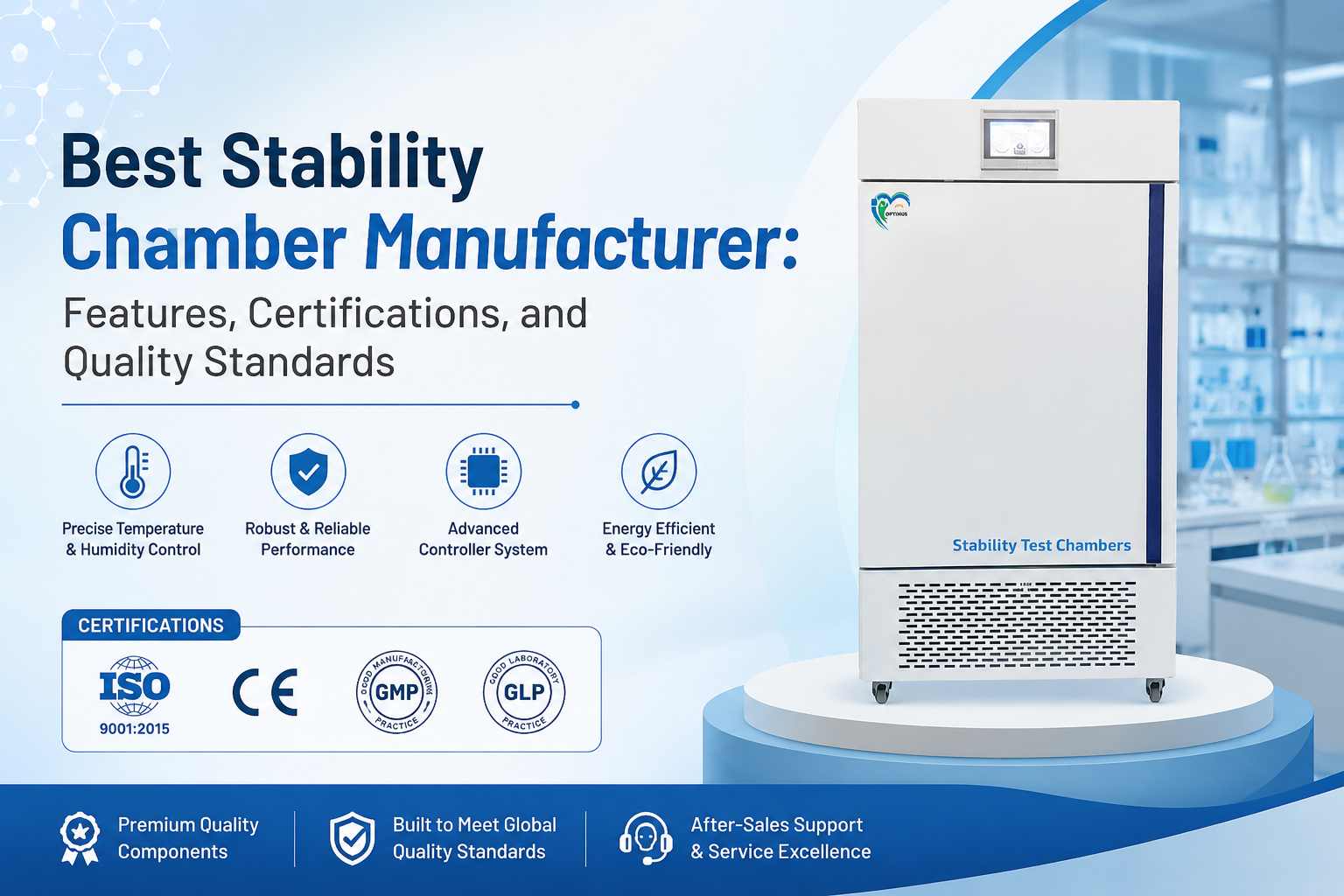
Quick Answer
A dependable stability chamber manufacturer builds equipment that holds temperature and humidity within tight tolerances (typically ±0.2°C and ±2–3% RH), uses CE-certified components, offers double-walled PUF insulation, and provides validation support for ICH Q1A stability studies. Getrus International, a Stability Chamber Manufacturer India with over 20 years of engineering experience, designs chambers that meet these exact benchmarks for pharmaceutical, biotechnology, and research applications.
If you’re evaluating suppliers, the fastest way to separate genuine manufacturers from traders is to check three things: temperature/humidity accuracy specs, certification documentation, and after-sales service coverage. We break down all three below.
What is a Stability Chamber?
A stability chamber is a specialized, highly controlled environmental enclosure used to test how products react to specific conditions like temperature, humidity, and light over time. It allows manufacturers to accurately simulate real-world climates, determine product shelf life, and ensure compliance with regulatory standards.
Key Applications
Stability chambers are critical in multiple industries to verify product durability, safety, and quality:
- Pharmaceuticals: Used extensively for drug stability studies to establish expiration dates and ensure medications survive transport and storage.
- Food & Beverages: Tests how long packaged foods last and checks for spoilage under different climate conditions.
- Cosmetics: Ensures products like creams, lotions, and makeup do not separate, degrade, or grow bacteria over time.
- Electronics & Materials: Evaluates the aging, weathering, and performance of electronic components and industrial materials.
What is a Stability Test Chamber Used For?
A stability test chamber creates and maintains controlled temperature, humidity, and (in some models) light conditions to study how drugs, biologics, food products, and materials behave over time. It’s used to:
- Determine shelf life and expiry dating of pharmaceutical products
- Conduct accelerated and long-term stability studies per ICH Q1A(R2) guidelines
- Test biological samples, seeds, and mechanical or electronic components
- Support R&D in pharmaceutical, biotechnology, and food industries
Key Features to Look for in a Stability Chamber
Not all chambers are built to the same standard. Here’s what genuinely separates a premium unit from a basic one.
1. Construction and Insulation
- Double-walled modular structure with thick PUF (polyurethane foam) insulation — typically 3 inches — for stable internal conditions
- Stainless steel interior with mild steel powder-coated or stainless steel exterior for corrosion resistance
- Heavy-duty door hinges and gaskets that maintain a uniform seal and prevent temperature/humidity leakage
2. Temperature and Humidity Control
| Parameter | Typical Industry-Grade Range |
| Temperature Range | -20°C to 70°C (model-dependent) |
| Temperature Accuracy | ± 0.2°C |
| Temperature Uniformity | ± 2.0°C |
| Humidity Range | Ambient +5% to 95% RH |
| Humidity Accuracy | ± 2.0% RH |
| Humidity Uniformity | ± 3.0% RH |
A quality chamber should hit these figures consistently, not just on a spec sheet.
3. Digital Controller and Alarm Systems
Look for a digital dual LED controller with 0.1°C readability, auto-tuning capability, and programmable ramp-and-soak profiles (useful for accelerated stability protocols). Equally important are the safety alarms:
- Door-open alarm
- Temperature and humidity high-deviation alarm
- Water input failure alarm
- Audio-visual alarm on overshoot/undershoot
These aren’t optional extras — they’re what protect your data integrity during unattended, long-duration studies.
4. Air Circulation and Refrigeration
A variable-speed circulation fan improves temperature uniformity, reduces energy consumption, and lowers noise levels compared to fixed-speed motors. Pair this with an air-cooled refrigeration system, which offers low power draw, corrosion resistance, and minimal maintenance over the chamber’s operating life.
5. Build for Long-Term Use
- Stainless steel trays with adjustable height for flexible sample loading
- Lockable caster wheels for safe mobility within the lab
- Glass door option for visual sample monitoring without disturbing internal conditions
Certifications and Quality Standards that Matter
Certifications can feel like alphabet soup — ISO this, GMP that. But a few of them genuinely indicate whether a manufacturer knows what they’re doing.
Important Certifications to Check
| Certification / Standard | What it Means | Why it Matters |
| ISO 9001 | Quality management system certification | Confirms consistent manufacturing and quality control processes |
| ICH Q1A(R2) | Global guideline for stability testing conditions | Ensures your chamber conditions align with international regulatory expectations |
| GMP Compliance | Good Manufacturing Practice adherence | Critical for pharma companies seeking regulatory approval |
| CE Marking | European conformity for safety and performance | Indicates the equipment meets recognized safety standards |
| NABL Calibration | Nationally accredited calibration traceability | Gives your data legal and scientific credibility during audits |
For a broader view of quality frameworks referenced in pharmaceutical testing, the ICH official guidelines are a useful external reference.
Getrus International: Stability Chamber Manufacturer India
Getrus International has been engineering laboratory, pharmaceutical, and clean room equipment since 2002, with a manufacturing base in Bahadurgarh, Haryana, and a corporate office in New Delhi. Over 20+ years, the company has:
- Delivered 8,000+ products to clients across 35+ countries
- Built a dealer network of 500+ partners nationwide
- Maintained CE-certified manufacturing for chambers, incubators, and clean room systems
- Backed every installation with dedicated pre-sales and after-sales technical support
Our Stability Test Chambers are engineered specifically for pharmaceutical, biotechnology, food industry, and research institute applications, with the double-walled PUF insulation, ±0.2°C temperature accuracy, and full alarm systems detailed above — all backed by CE certification for safety and reliability.
How to Choose the Right Supplier: A Practical Checklist
Before signing a purchase order, verify:
- Does the manufacturer actually manufacture — or are they reselling imported/OEM units without in-house engineering support?
- Can they share calibration and CE documentation upfront, not just after the sale?
- Do they offer installation, validation support, and preventive maintenance contracts?
- What’s the warranty period, and does it cover the compressor and controller separately?
- Can they customize chamber size and setpoints for your specific study protocol?
A manufacturer that answers all five confidently, with documentation to back it up, is worth prioritizing over one offering only the lowest price.
FAQs
1. What is the ideal temperature accuracy for a pharmaceutical stability chamber?
Industry-grade chambers should maintain temperature accuracy within ±0.2°C and uniformity within ±2.0°C to meet ICH Q1A stability testing requirements reliably.
2. Why is CE certification important when buying a stability chamber?
CE certification confirms the chamber meets recognized European safety and performance standards, giving buyers assurance the equipment has passed formal testing for electrical safety, EMC, and build quality — a strong trust signal even outside the EU.
3. What’s the difference between a stability chamber and a humidity chamber?
A stability chamber controls both temperature and humidity together for long-term shelf-life and degradation studies, while a humidity chamber may focus more narrowly on humidity-only testing. Many stability chambers, like those from Getrus International, combine both functions in one unit.
4. How long do pharmaceutical stability studies typically run in these chambers?
Long-term stability studies commonly run 12–36 months at controlled conditions, while accelerated studies at higher temperature and humidity (e.g., 40°C/75% RH) usually run 3–6 months to predict shelf life faster.
5. Can stability chambers be customized for specific lab requirements?
Yes. Reputable manufacturers offer customization in chamber size, temperature/humidity range, tray configuration, and alarm sensitivity to match specific study protocols and lab space constraints.
Conclusion
A stability chamber is only as reliable as the manufacturer standing behind it. Accuracy specs, certifications, insulation quality, and after-sales support all determine whether your stability data holds up under regulatory scrutiny — or falls apart during an audit. Getrus International brings over two decades of manufacturing experience, CE-certified builds, and nationwide support to pharmaceutical, biotech, and research labs across India and beyond.
Ready to upgrade your lab’s stability testing setup? Explore our Stability Test Chambers or get a free quote from Getrus International today.
About the Author
Tarun Sharma is the CEO of Getrus International, established in 2002. With over two decades of engineering expertise, he has built the company into a trusted manufacturer of temperature and humidity test chambers, IVF lab equipment, and clean room solutions, serving hospitals, pharmaceutical companies, and research institutions across 35+ countries with technical precision and genuine customer-first service.