

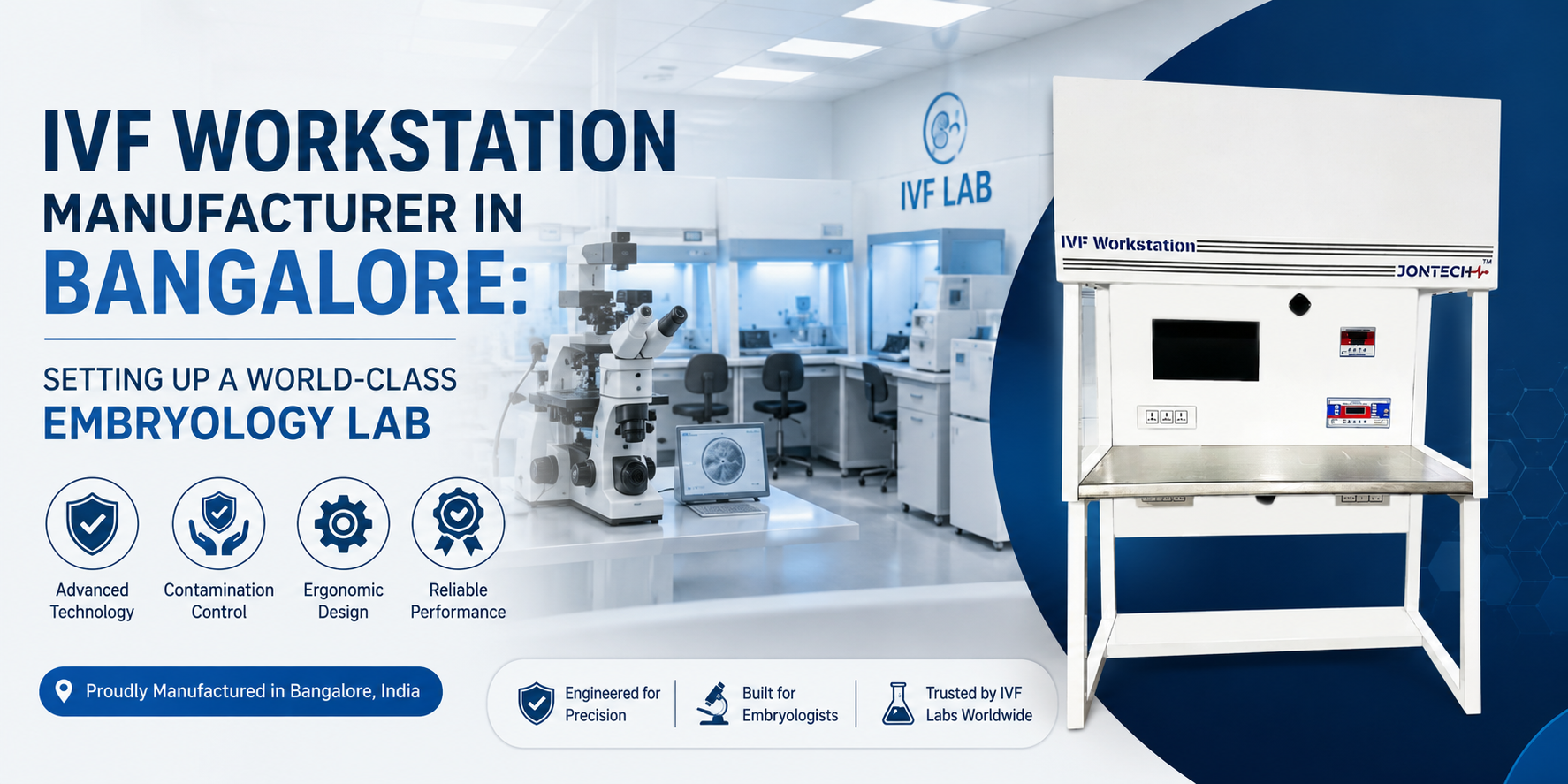
Bangalore’s fertility sector is expanding fast, and clinics opening or upgrading their embryology labs need one thing above all: an IVF workstation that keeps gametes and embryos safe from contamination, temperature swings, and vibration. Getrus International is a specialist IVF Workstation Manufacturer in Bangalore and across India, engineering HEPA-filtered, vertical laminar airflow workstations built to help clinics meet ISO Class 5 handling standards.
Quick Answer
An IVF workstation is a temperature-controlled, HEPA-filtered work surface where embryologists handle oocytes, sperm, and embryos outside the incubator. A good workstation combines dual-stage HEPA/VOC filtration, vertical laminar airflow, a microprocessor-controlled heated stage, UV sterilization, and anti-vibration support. Getrus International manufactures these workstations in India with stainless-steel worktops, low-noise blowers (under 60 dB), and digital LCD/HMI controls — supplied and installed for fertility clinics in Bangalore and nationwide.
What is an IVF Workstation?
An IVF workstation is a specialized, enclosed work surface used in embryology labs where embryologists handle eggs (oocytes), sperm, and embryos outside the incubator — during procedures like oocyte retrieval assessment, ICSI (intracytoplasmic sperm injection), fertilization checks, and embryo grading.
Because gametes and embryos are extremely sensitive to their environment, an IVF workstation is engineered to protect them during this handling. Here’s what makes it different from a regular lab bench:
Core features:
- HEPA filtration – Filters air to ≥99.97% efficiency at 0.3 microns, creating a near-sterile “Class 100” zone right where the embryologist is working
- Vertical laminar airflow – A continuous, gentle downward flow of filtered air that pushes contaminants away from the work surface
- Heated work surface – Microprocessor-controlled temperature regulation to keep samples at body-like temperature (since embryos are very sensitive to temperature fluctuation)
- VOC filtration (optional) – Removes volatile organic compounds from paints, plastics, and cleaning agents, which research has linked to poor embryo development
- UV sterilization – An inbuilt germicidal lamp to control microbial contamination when the unit isn’t in active use
- Vibration isolation – Anti-vibration legs/levellers, since even minor vibration can affect delicate micromanipulation work
- Safety glass panels – For visibility and to shield the operator, often with an ergonomic, adjustable design for long procedures
In short: it’s the controlled “operating table” for gametes and embryos — combining filtered air, stable temperature, and vibration control in one unit, so fertilization and embryo development happen in the cleanest, most stable environment possible.
Key Components of a World-Class IVF Workstation
Not all workstations are created equal. A genuinely lab-grade IVF workstation typically includes several integrated systems working together, not just a table with a microscope on it.
Core Components of an IVF Workstation
| Component | What it Does | Why it Matters |
| Heated Stage & Base | Maintains a consistent 37°C surface temperature | Prevents thermal stress on gametes and embryos |
| HEPA/VOC Filtration | Filters airborne particles and volatile chemicals | Reduces contamination risk and toxin exposure |
| Laminar Airflow System | Creates a unidirectional, clean air curtain | Keeps the work zone free of contaminants during procedures |
| Ergonomic Design | Adjustable height, comfortable seating alignment | Reduces embryologist fatigue during long procedures |
| Integrated Microscope Mount | Stable, vibration-free platform for the microscope | Ensures precision during ICSI and embryo grading |
| Gas Line Ports | Connects to CO2/N2 supply where needed | Supports controlled-atmosphere procedures |
Getrus International IVF Workstation — Key Specifications
| Feature | Specification |
| Body construction | Corrosion-resistant galvanized sheet metal, powder-coated |
| Worktop | High-grade stainless steel, chemical-resistant |
| Filtration | Pre-filter (10 micron) + HEPA (≥99.97% @ 0.3 micron) + optional VOC filter |
| Airflow | Vertical laminar, brushless blower, <60 dB noise |
| Temperature control | Microprocessor-based, dual digital display |
| Configuration | Single or two-person (6 ft. x 2 ft.) with independent heating zones |
| Controls | LCD/HMI touch panel — airflow, heating, UV, illumination |
| Power | 220–230V AC, 50–60 Hz |
| Safety | UV sterilization, tempered/acrylic glass panels |
Key Benefits of Choosing the Right IVF Workstation
Here’s what a well-designed, properly manufactured workstation brings to a fertility lab:
- Consistent embryo culture conditions — stable temperature and air quality reduce variability across procedures
- Improved lab workflow — everything the embryologist needs is within reach, reducing procedure time
- Lower contamination risk — proper filtration keeps VOCs and particulates away from gametes and embryos
- Better long-term ROI — durable, well-built stations need fewer repairs and replacements
- Regulatory compliance — meets the standards expected by accreditation bodies and quality audits
- Staff comfort and retention — ergonomic design reduces fatigue for embryologists doing back-to-back procedures
Setting Up an Embryology Lab in Bangalore: A Practical Checklist
- Plan the zoning first. Separate the embryology/ICSI area from andrology and cryopreservation zones to reduce cross-contamination risk.
- Match room-level air quality to workstation-level air quality. Background room air (ISO Class 7 or better) should support the Class 100 microenvironment at the workstation surface.
- Test for VOCs before installation. New construction materials, paints, and adhesives can off-gas for 90–120 days — schedule air-quality testing before moving equipment in.
- Choose configuration based on team size. A two-person workstation with independent heating zones suits busy clinics running parallel procedures without duplicating equipment.
- Plan for maintenance from day one. HEPA filters, blower motors, and temperature sensors need scheduled servicing — confirm your manufacturer offers installation, calibration, and after-sales support.
- Verify compliance documentation. Ask your manufacturer for filter efficiency certificates, noise-level test data, and material specification sheets for ART/NABH audit readiness.
Why Clinics in Bangalore Choose Getrus International
- 20+ years of manufacturing experience (established 2002), with laboratory, clean room, and IVF equipment supplied across India and internationally.
- End-to-end IVF lab support — workstations, CO₂ incubators, ICSI tables, andrology workstations, dry incubators, and clean room integration under one roof.
- Installation and after-sales service, including calibration, preventive maintenance, and technical support — not just equipment supply.
- Custom-engineered solutions for clinics with specific space, workflow, or capacity requirements.
Explore the complete range on the IVF Workstation product page or browse related IVF & IUI laboratory equipment.
FAQs
1. What is an IVF workstation used for?
An IVF workstation provides a filtered, temperature-controlled surface where embryologists handle oocytes, sperm, and embryos during retrieval, fertilization, and grading — protecting them from airborne contaminants and temperature fluctuation.
2. What air quality standard should an IVF workstation meet?
Most accreditation frameworks recommend ISO Class 5 conditions at the work surface, with HEPA filtration rated ≥99.97% efficiency at 0.3 microns, supported by ISO Class 7 or better background room air.
3. Does Getrus International supply IVF workstations outside Bangalore?
Yes. Getrus International manufactures and supplies IVF workstations and complete embryology lab equipment to fertility clinics across India, including Bangalore, Chennai, Delhi NCR, and other cities.
4. Can an IVF workstation support two embryologists at once?
Yes. Getrus International’s 6 ft. x 2 ft. two-person workstation has independent heating zones, allowing each operator to control temperature separately for energy efficiency and flexibility.
5. What after-sales support comes with an IVF workstation purchase?
Getrus International provides installation, calibration, preventive maintenance, HEPA filter replacement guidance, and dedicated technical support to keep the workstation compliant and running reliably.
Conclusion
A world-class embryology lab starts with a workstation engineered for the sensitivity of gamete and embryo handling — not general-purpose lab furniture adapted for the job. Getrus International combines HEPA/VOC filtration, precision temperature control, vibration isolation, and two-decade manufacturing expertise to help Bangalore’s fertility clinics build labs that meet international standards from day one.
Ready to upgrade your embryology lab? Request a free quote from Getrus International or call +91 9717076743 to speak with our IVF equipment specialists.
About the Author
Tarun Sharma is the CEO of Getrus International, established in 2002. With over two decades of engineering expertise, he has built the company into a trusted manufacturer of temperature and humidity test chambers, IVF lab equipment, and clean room solutions, serving hospitals, pharmaceutical companies, and research institutions across 35+ countries with technical precision and genuine customer-first service.