

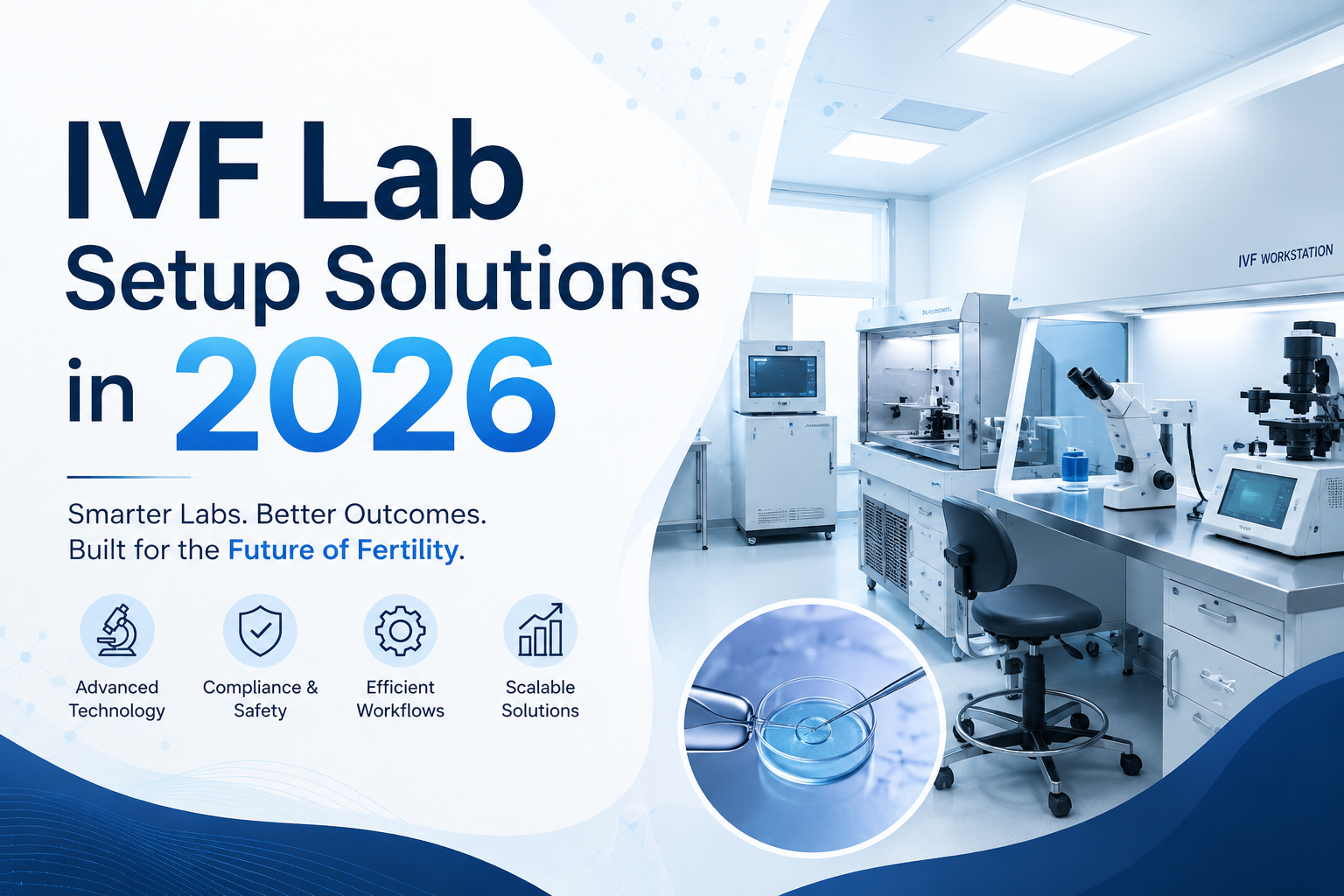
Setting up an IVF lab in 2026 requires a controlled environment with Class 10,000 (ISO 7) or better cleanroom standards, CO₂ incubators, laminar airflow IVF workstations, micromanipulators, cryostorage systems, and air quality monitoring. A complete IVF lab setup typically costs between ₹80 lakh to ₹3 crore depending on clinic size, equipment grade, and location. Getrus International provides end-to-end IVF Lab Setup Solutions — from equipment supply to installation and commissioning.
Introduction
If you’re building or upgrading a fertility clinic in 2026, getting your IVF lab setup right is the single most critical decision you’ll make.
The equipment you choose, the airflow you design, the workstations you install — all of it directly impacts embryo quality, patient outcomes, and your clinic’s reputation.
Yet many clinics still underspend on infrastructure and overspend on marketing. This guide flips that priority.
Whether you’re a reproductive medicine specialist, a hospital administrator, or an investor entering the fertility sector, this article walks you through every essential component of a modern IVF lab — with practical insights from Getrus International, a leading IVF Lab Equipment Manufacturer and IVF workstation manufacturer trusted by fertility clinics across India and beyond.
Why 2026 is a Pivotal Year for IVF Lab Infrastructure
The global IVF market is projected to surpass USD 36 billion by 2030, growing at a CAGR of over 8%. In India alone, the number of ART cycles performed annually has crossed 2.5 lakh and continues to climb.
Regulatory bodies like the Indian Council of Medical Research (ICMR) and international bodies such as ESHRE (European Society of Human Reproduction and Embryology) are tightening quality standards for ART labs. Clinics that don’t meet these standards risk license cancellation — and more critically, poor patient outcomes.
The message is clear: your IVF lab infrastructure is no longer optional infrastructure. It is your core clinical asset.
Core Components of an IVF Lab Setup
1. Cleanroom Design and Air Quality Control
The IVF lab environment must maintain:
- ISO Class 5 (Class 100) air quality at critical work zones (near open dishes and gametes)
- ISO Class 7 (Class 10,000) for the general lab area
- VOC (Volatile Organic Compound) levels below 0.5 ppm — elevated VOCs from construction materials, cleaning agents, or plastics are a leading, often overlooked, cause of poor embryo development
Practical tip: Always test air quality before bringing in equipment. A new building’s paint and adhesives can off-gas VOCs for 90–120 days. Schedule air quality testing at least 3 months post-construction.
2. IVF Workstations — The Heart of Your Lab
The IVF workstation is where oocyte retrieval, fertilisation, and embryo handling happen. Choosing the wrong one is a mistake you’ll pay for in failed cycles.
A high-quality IVF workstation must offer:
- Integrated HEPA + activated carbon filtration
- Stable, vibration-free surface
- Built-in heated stage (37°C ± 0.1°C precision)
- Optional CO₂/O₂ gas overlay system for open-dish work
- Ergonomic design for operator comfort during long procedures
Getrus International manufactures IVF workstations engineered specifically for Indian climatic conditions — accounting for humidity, dust load, and power fluctuation — while meeting international ESHRE and ICMR compliance standards.
“The workstation isn’t just furniture — it’s a microenvironment. Temperature deviation of even 0.5°C during gamete handling can compromise fertilisation rates.” — IVF Lab Consultant, Mumbai
3. CO₂ Incubators
Embryos spend most of their development time inside CO₂ incubators. This makes incubator quality non-negotiable.
Key specifications to look for:
| Feature | Standard Requirement |
| Temperature stability | ±0.1°C |
| CO₂ concentration accuracy | ±0.1% |
| Recovery time after door opening | < 3 minutes |
| HEPA filtration | Mandatory |
| Humidity control | 95–98% RH |
Benchtop incubators (like Minc or K-Systems) are increasingly preferred over large-capacity units for their faster recovery and lower contamination risk per chamber.
4. Micromanipulation Systems (ICSI Setup)
For labs performing Intracytoplasmic Sperm Injection (ICSI), a micromanipulator system is essential. This includes:
- Inverted microscope (Nikon, Olympus, or Leica)
- Micromanipulator arms (Narishige or Eppendorf)
- Anti-vibration table
- Heated stage attachment
The anti-vibration table is often deprioritised in budgets. Don’t. Even floor vibrations from an elevator or HVAC unit nearby can disrupt ICSI procedures and reduce fertilisation rates.
5. Cryopreservation and Liquid Nitrogen Storage
Embryo and gamete cryopreservation requires:
- Programmable cryopreservation machines (for slow freezing, though vitrification is now standard)
- Vitrification devices and cryotops
- Liquid nitrogen storage dewars with alarm systems
- Continuous LN₂ monitoring with remote alerts
Critical compliance note: As per ICMR ART guidelines, all cryostorage tanks must have dedicated alarm systems that trigger when LN₂ levels drop below safe thresholds. This is now mandatory, not optional.
6. Sperm Analysis and Preparation Equipment
A complete andrology section within the IVF lab requires:
- Computer-Assisted Sperm Analysis (CASA) system
- Phase-contrast microscope
- Centrifuges (standard and density gradient)
- Heated microscope stage
- Sperm freezing media and cryovials
7. Environmental Monitoring Systems
Modern IVF labs use continuous monitoring for:
- Temperature (all incubators and refrigerators)
- CO₂ and O₂ levels
- VOC concentration
- Humidity
- Particle count
Getrus International offers integrated IVF lab monitoring solutions that send real-time alerts to lab managers’ smartphones — ensuring 24/7 protection of gametes and embryos.
IVF Lab Layout: Zoning Principles
A well-designed IVF lab follows a directional airflow and contamination control principle:
Reception → Consultation → Andrology → OT/OPU Area → IVF Lab Core → Embryology Lab → Cryostorage
- No cross-contamination zones between andrology and embryology
- Positive pressure in the embryology lab relative to surrounding areas
- Separate air handling units (AHUs) for the IVF lab — never share with OT or OPD
- Interlocking airlock entry to prevent pressure disruption
Estimated IVF Lab Setup Budget (2026 — India)
| Lab Scale | Approximate Cost (INR) |
| Basic (3–5 cycle/day) | ₹80 lakh – ₹1.2 crore |
| Mid-sized (8–12 cycles/day) | ₹1.5 crore – ₹2.2 crore |
| High-volume (15+ cycles/day) | ₹2.5 crore – ₹4 crore |
Note: Costs vary based on equipment brand, city, civil work requirements, and regulatory compliance consultancy.
Getrus International: Your End-to-End IVF Lab Setup Partner
Getrus International is a dedicated IVF lab equipment manufacturer and IVF Workstation Manufacturer providing complete IVF lab setup solutions across India and international markets.
What Getrus offers:
- Custom-manufactured IVF workstations built for Indian conditions
- End-to-end IVF lab setup consultation and project management
- Equipment supply, installation, calibration, and commissioning
- Staff training and SOPs for lab operations
- Post-installation AMC (Annual Maintenance Contracts)
- Regulatory compliance support (ICMR, NABH, ISO)
Getrus International combines deep clinical understanding with engineering precision — ensuring that every lab they set up is optimised not just for compliance, but for outcomes.
Call us today to speak with our IVF lab setup consultant.
Contact us for a free site assessment and customised equipment proposal.
Visit us at our showroom to experience our IVF workstation range in person.
Frequently Asked Questions (FAQs)
Q1. What is the minimum space required to set up an IVF lab?
A functional IVF lab requires a minimum of 600–800 sq. ft. for a basic setup handling 3–5 cycles per day. High-volume labs typically need 1,500–2,500 sq. ft. The space must accommodate the embryology lab, andrology section, OPU (egg retrieval) area, and cryostorage room separately, with proper airlock zones between them.
Q2. How long does it take to set up an IVF lab from scratch?
A complete IVF lab setup, including civil work, HVAC installation, equipment procurement, installation, calibration, and regulatory compliance checks, typically takes 4 to 8 months. Working with an experienced IVF lab setup solutions provider like Getrus International can reduce this timeline significantly through parallel project management and pre-certified equipment.
Q3. What air quality standard is required for an IVF lab?
The embryology section of an IVF lab should maintain at least ISO Class 7 (Class 10,000) air quality, with the immediate work area at oocyte and embryo handling stations meeting ISO Class 5 (Class 100). VOC levels must be kept below 0.5 ppm. Continuous air quality monitoring is strongly recommended and increasingly mandated by accreditation bodies.
Q4. What is an IVF workstation and why is it important?
An IVF workstation is a specialised, enclosed work surface equipped with HEPA filtration, activated carbon filters, a precise heated stage, and gas overlay capability. It creates a controlled microenvironment for handling oocytes, sperm, and embryos outside the incubator. A poor-quality workstation exposes gametes to harmful temperatures, VOCs, and particulates — directly impacting fertilisation rates and embryo quality.
Q5. Does Getrus International provide IVF lab setup solutions outside India?
Yes. Getrus International provides IVF lab setup solutions and IVF workstation manufacturing for fertility clinics in South Asia, Southeast Asia, the Middle East, and Africa. Their equipment is designed for diverse climate conditions and can be configured to meet local regulatory requirements. Contact Getrus International to discuss international project requirements.
Conclusion
Setting up an IVF lab in 2026 is a significant clinical and financial undertaking — but one that rewards careful planning with exceptional patient outcomes and long-term clinic growth.
From cleanroom design and air quality to IVF workstations, CO₂ incubators, and cryostorage systems, every component matters. And the difference between a functional lab and a high-performing one often comes down to the quality of your equipment supplier and setup partner.
Getrus International brings together manufacturing expertise, clinical insight, and project management capability to deliver IVF lab setup solutions that are built for performance, compliance, and longevity.
Ready to Build Your IVF Lab?
Contact Getrus International today for a free consultation, site assessment, and customised equipment proposal.
Call now to speak with an IVF lab setup specialist.
Email us your project requirements and get a detailed quote within 48 hours.
Visit our facility to see our IVF workstations and lab equipment in action.
Getrus International — Precision Equipment for Life-Giving Science.